Sentimental Value (2025)
Joachim Trier
Drama
aka Affeksjonsverdi
Norway | Germany | Denmark
Renate Reinsve | Stellan Skarsgård | Inga Ibsdotter LilleaasAwards & Festivals
3 Win, 6 Nomination

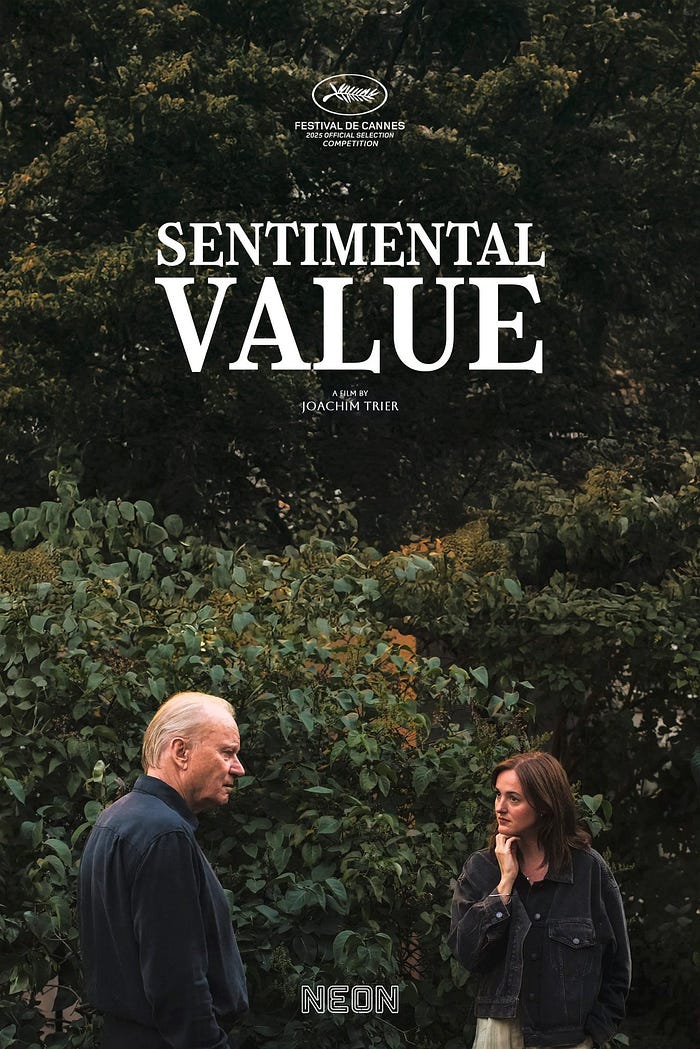
Joachim Trier’s latest film Affeksjonsverdi (internationally titled Sentimental Value) premiered in the main competition at the 2025 Cannes Film Festival. After the screening, it received a 19-minute standing ovation and was especially praised for its narrative texture built around emotional transmission, family dynamics, and confronting the past. This film, in which Trier reunites with longtime collaborator and screenwriter Eskil Vogt, carries a thematic kinship with his earlier works (especially Oslo, August 31st and The Worst Person in the World), but this time, the focus extends beyond the inner world of the individual to the generational affective currents of familial bonds.
The first striking element in the film is the influence of Dutch philosopher Baruch Spinoza; it’s as if the screenplay was written by Trier, Vogt, and Spinoza together in a secluded villa in the Norwegian fjords. As we will explore in detail below, we will read the film through the lens of Spinoza, with touches of Ulus Baker.
The film’s original Norwegian title, Affeksjonsverdi — directly translated as “sentimental value” or “value of affect” — is a striking choice. In Spinoza’s philosophy, affectio refers to a state in which a body is affected by other things, beings, or objects; it is a trace, an orientation, a residual impact. Affect, meanwhile, is the emotional response to that state of being affected — a power of existence that either increases or diminishes. Therefore, the value of an affect is not only about the emotion experienced in the moment, but the entire history inherited from the past, embedded in the body, compressed with images. Looking at the film, the mother’s death triggers the unraveling of suppressed affects in the family members. Gustav’s attempt to make a film, Nora and Agnes returning to Oslo, the memories embedded in the house… Each of these is an attempt to displace an old affect with a new one.
It is apt to begin the in-depth analysis with the house, which plays an almost character-like role in the film. The house’s dominant spatial memory is unmistakable — the rooms, objects, drawers, the spaces the camera navigates through… Each is a vessel of affect. As Trier’s camera probes the memory of the house, there are displacements among the images. After the death of their mother, Gustav, Nora, and Agnes return to their old house in Norway, and are confronted by the images embedded in the walls of the past, unspoken sentences, and repressed affects. The house emerges as a physical representation of memory — the space the camera focuses on behaves almost like a living character, and the influence of the past lingers like a ghost over the characters and the spaces…
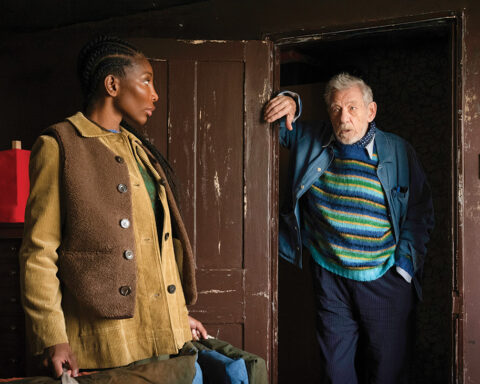
The space, which automatically creates an effect on us, internally impacts the “power” of the characters. Nora and Agnes, walking around the house, encounter a transformative experience that either increases or diminishes their bodily capacity in Spinozist terms. One of the key scenes in the film is when Nora and Agnes are tidying up the clutter and talk about each object. In this scene, Nora initially ignores the red glass vase from the honeymoon; she stays silent, implying that the vase has no special value. But later, while talking to Agnes, we see her undergo a transformation and almost hysterically claim ownership over the same vase — as if the object is not just a thing, but carries a fragment of the past, a residue of family ties. This sudden emotional outburst aligns with Spinoza’s view that we want to keep what we love close: Love or attachment is not merely a conscious choice, but a power imposed upon us by objects like the vase. The idea that love and hate can simultaneously become attachment — even slavery — and that by clinging to an object, we also become its “slave,” is dramatically exposed in this scene. Nora’s initial dismissal of the vase and her later urge to protect it illustrate how an affect can grow, change, and yet leave permanent marks on the body over time.
According to Baker, Spinoza does not simply state that the one who loves wants to keep the loved object close, and the one who hates wants to push it away — these are almost tautological. Love is keeping the object near; hate is the effort to remove it. These are the perspectives of old theories of love — for instance, the idea that love is a desire for union, or the “complementarity” theory — mere “nominal” definitions. While love and hate correspond to an increase in conscious awareness, they also underline a previously begun process of alienation. What must be thought about is how attachment to the object of love or hate also entails a kind of slavery. And this kind of slavery is heavy, because the simpler, more immediate character of joy and sadness is constantly at work within it. (Surface Science Fragments)
Again drawing from Spinoza’s equation “Love/Hate = Attachment to Object = Slavery,” Nora’s yearning for her father while wanting to keep her distance from him; Agnes’s emotionally distant connection to their mother; Gustav’s obsessive clinging to the past… All of these characters are tied to an object of the past (the mother, the house, memories, childhood). This attachment both defines and limits them. As Spinoza says, it is a form of “slavery.” The film makes this slavery visible and explores possible resolutions through art, confrontation, and emotional openness.
The silence and indirect expressions within the family resemble what Spinoza calls passive affectus: Sorrow or desire that diminishes the character’s capacity and creates internal tension. As the film progresses, this passivity gives way to active emotion. The film-within-a-film that Gustav creates becomes a tool for effect — not face-to-face but emotionally stirring. This parallels Spinoza’s concept of affective interaction: art enables the transmission of emotion that enhances the body’s power.
At this point, the concept of Conatus comes into play. “Conatus is the effort of everything to persist in its own being. This effort is the essence of that thing.” (Ethics, Part III, Proposition 6: Unaquaeque res, quantum in se est, in suo esse perseverare conatur.) Conatus plays a role in the persistence or forced transformation of images; an image (or memory) can only be displaced by a stronger one. Failing in direct communication with his daughters and even appearing inept or malicious, Gustav opts for an indirect process of reconnection and transformation; after all, if not a good father, he is a good director. Gustav approaches the creative process as a “strategy of persistence,” attempting to make a personal film and reconstruct his essence by confronting the past. Nora and Agnes, after suppressing their emotions following their mother’s death, attempt to move from passivity (passive affectus) to activity. In doing so, each redefines their way of persisting in being: a kind of moral and existential conatus.
This reflects a zone of tension that Ulus Baker frequently emphasizes in his reading of Spinoza: Affects are not merely accumulated; they also become forces that govern the body. Nora and Agnes’s return to their childhood home is not only a confrontation with their father but an emotional battle with the images embedded in the past. In Spinozist terms, the house becomes the space where conatus materializes. Gustav’s decision to start filming inside the house in pursuit of his directorial ambition is an attempt to “stage” and perhaps reframe the past. Yet Trier is never sure whether this act is ethically or emotionally redemptive. Thus, Gustav’s project appears not as a memory exercise, but as a desperate act of conatus — an attempt to make his existence meaningful, yet inevitably colliding with the affects of others. This effort is not merely a physical survival instinct; it also encompasses emotional, intellectual, and spiritual continuity. The characters — especially Gustav and his daughters Nora and Agnes — represent a fractured but unextinguished form of conatus: Each is tied to the images, memories, and to each other, yet these bonds have either been suspended or frozen. As Baker notes, indifference is never truly a “zero state”; if sustained over time, it inevitably turns into sorrow. Sentimental Value can be read as a film that attempts to thaw this frozen affective state.
Every scene in the film functions like a surface recording these emotional vibrations. The transitions of light in the house, the silences, the gazes, even the unsaid things between characters, all permeate the space as affects. What Spinoza calls the “formal reality of the idea” finds its counterpart precisely in Trier’s cinematography: Emotions are not merely told; they are constructed, merged with space, stretched over time. That’s why the indifference in the film, as Baker writes, is not a “zero state” but a form of frozen grief. Even characters who don’t speak, do speak; because affect doesn’t stay silent — it merely changes direction.
At the film’s end, instead of complete resolution or reconciliation, we sense that the affects have entered a new mode of circulation. According to Spinoza, an affect can only be displaced by a stronger affect. Perhaps the mother’s death holds the power to finally shake the fragile images of the past. But what follows is not peace, but another kind of uncertainty. Because even as affects transform, they leave a mark. The value of affect is never erased; it merely shifts direction.
Trier’s Affeksjonsverdi is a film about confronting the past, tracing the marks of affect, and ultimately not being able to escape the roles these marks have assigned us. Its title refers not only to a few stored objects in the house, but to the value placed on the affects that have accumulated in the characters’ bodies and grown silently. And this value can neither be fully sanctified nor easily abandoned. It is a force that courses through life, permeates memory, and continues to govern the body.
A sentence Trier uttered in his interview with Variety almost encapsulates the entire film:
“People that deny emotions make terrible choices.”
Nil Birinci