Marty Supreme
________________________
Josh Safdie
Drama | Sport
149′
U.S.A.
Timothée Chalamet | Gwyneth Paltrow | Odessa A’zion

Awards & Nominations
44 Wins, 287 Nominations
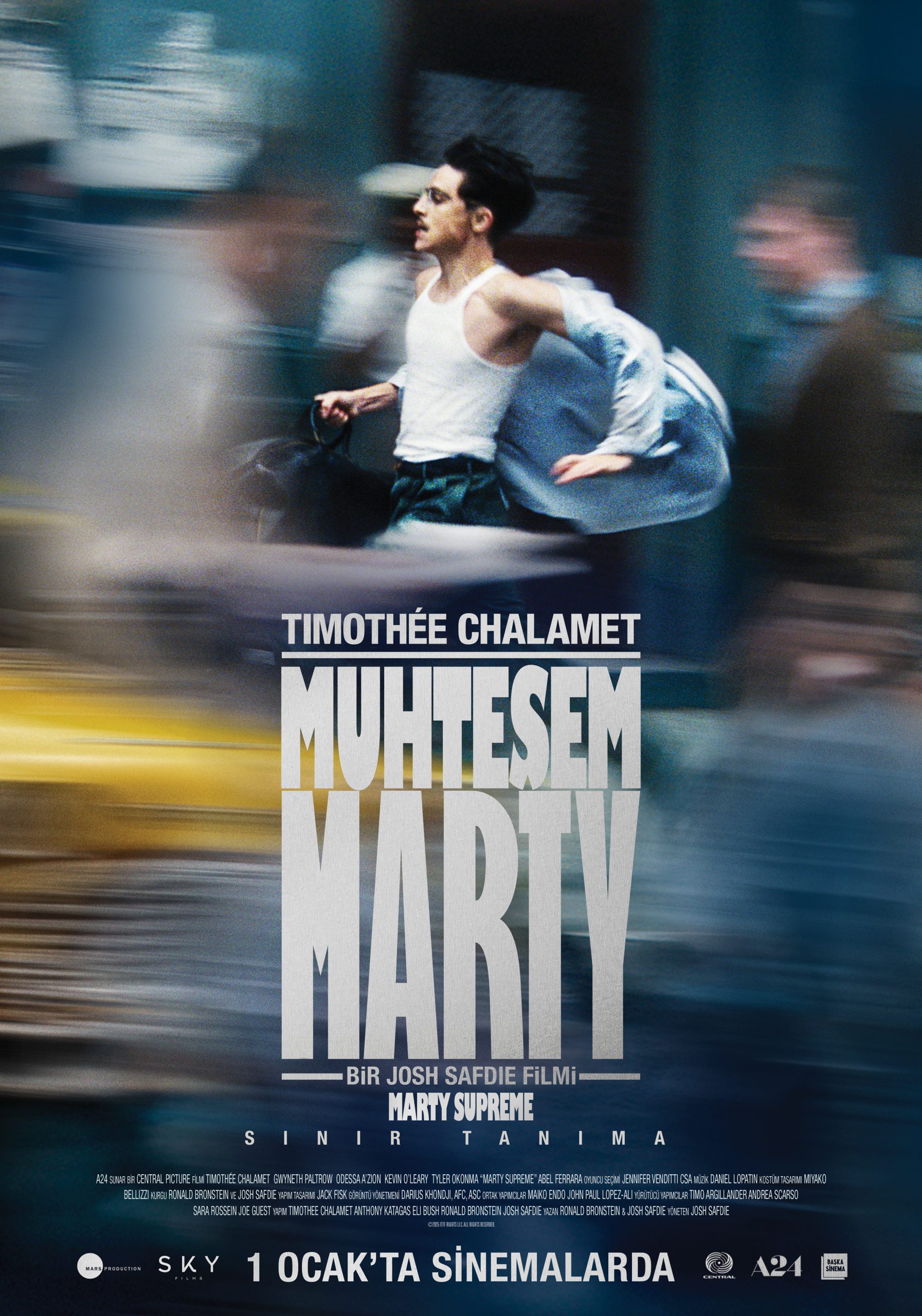
Marty Supreme, the latest—and perhaps most ambitious—chapter in Josh Safdie’s solo directorial journey, merges the “aesthetics of chaos” familiar from the Safdie brothers’ oeuvre with the rhythmic world of table tennis. From its very first moments, the film constructs its cinematic grammar around a high-revving mechanism, trapping the viewer within a breathless visual system.
The “anxiety cinema” that the Safdie brothers modernized with Good Time and Uncut Gems takes on a more refined yet equally savage form in Marty Supreme. Here, Josh Safdie builds the narrative not merely through plot, but through pure tempo and the mathematics of editing.
Continuous Motion and Cinematic Pressure
With its almost unrelenting pace, the film invites the viewer into a dizzying experience, once again showcasing Safdie’s signature “claustrophobic dynamism.” However, this time, the absence of a balancing “brake mechanism” transforms the film from a conventional narrative into a physical experience. The cinematography translates the narrowness of the table tennis table and the speed of the ball into a visual language that parallels the protagonist’s mental constriction. Rather than wide shots, close-ups focusing on sweat and frayed nerves pull the audience directly into this pressure chamber.
Yet the film’s greatest drawback lies in its refusal to grant the viewer a moment of pause amid this visual and rhythmic bombardment. Safdie sustains such a high level of chaos that key moments of character transformation or emotional beats risk being lost within the noise. A narrative that constantly operates at high intensity inevitably flirts with monotony. In certain parts of the script, the tendency to rely on speed rather than deepen character development becomes the main obstacle preventing the film from achieving masterpiece status. Instead of filling the gaps in Marty’s inner world, the narrative chooses to orbit them at high velocity.
The film’s use of lighting follows a high-contrast principle that mirrors the protagonist’s manic phases. Harsh interior lighting and deep shadows (chiaroscuro) are designed to emphasize Marty’s internal instability and social dissonance. Particularly in match scenes, the sharp, cold light falling on the table evokes not the elegance of sport but the unease of an interrogation room. This approach shifts the film away from a traditional sports drama toward the aesthetics of psychological thriller.
The color palette oscillates between the saturated Technicolor tones reflecting the late 1950s and early 1960s American dream and the “dirty pastels” characteristic of the Safdie style. Murky yellows, oxidized greens, and dominant reds evoke the retro spirit of the era; however, this saturation at times functions as an illusion, masking emotional gaps between scenes.
Deconstructing the Sports Film Genre
Marty Supreme rejects the conventions of classic sports films by transforming table tennis from an objective into a metaphor. The source of tension lies not in physical conflict, but in the character’s internal unrest and relentless ambition. In the film, table tennis becomes less a sport and more Marty’s sole mode of communication with the world—a rhythmic manifestation of his existential turmoil. This choice shifts the film away from a “success story” toward a portrait of obsession.
Rebirth as a Safdie Character
Undoubtedly, the film’s driving force is Timothée Chalamet’s portrayal of Marty, marking a new chapter in his career. Chalamet embodies the quintessential Safdie character—self-sabotaging and uncontrollable—with intense physical commitment. Marty’s incessant talkativeness and impatience become the primary elements shaping the film’s editing rhythm, further enhancing the character’s dramaturgical depth. Chalamet skillfully navigates the fine line between eliciting empathy and discomfort, and this unsettling charm forms the backbone of the film’s dramatic structure.
The Maturation of Safdie Cinema
Ultimately, Marty Supreme positions itself not merely as a story about a sport or an unconventional character, but as a film that seeks to redefine the physical and emotional relationship between cinema and its audience. By deliberately depriving the narrative of breathing space, Josh Safdie transforms the viewer from a passive observer into an active participant in this chaotic experience. While this choice prevents the film from being flawless, it is precisely what makes it unforgettable. As a cinematic reflection of uncontrolled ambition, relentless motion, and the exhaustion of the modern individual, Marty Supreme stands not only as the current peak of Safdie’s cinema, but also as a harbinger of even more radical forms to come.
Author: Zehra Eda Sert