Pluribus (2025)
Vince Gilligan
TV Series | Drama | Dystopian Sciene Fiction | 45′ x 9
USA
Rhea Seahorn | Karolina Wydra | Carlos-Manuel Vesga

Awards and Festivals
1 Wins , 8 Nominations

Pluribus: The Irresistible Allure of Surrender and the Cost of Free Will
Vince Gilligan — known worldwide for Breaking Bad, Better Call Saul, and The X-Files — has made a resounding return with his new project Pluribus. Since the day it premiered, the series has caused a major stir, debuting at the top of IMDb rankings and even earning a perfect score on Rotten Tomatoes.
At first glance, Pluribus may look like a science-fiction thriller, but at its core it is a work steeped in philosophical inquiry about human nature, individuality, and collective consent. Its first five episodes explore these questions through themes that resonate strikingly with the contemporary psychological landscape.
Haven’t we all, at some point, found ourselves trapped in a moment where it feels as though everyone around us is effortlessly living out that immaculate image of happiness — fulfilling responsibilities, enjoying life — while we alone struggle to fit in? In such moments, you may have imagined what it would feel like if your loneliness, your pain, your dysfunctions, and your misery could be absorbed into a collective mind, dissolving all your resentment and sorrow at once. At first, the idea seems alluring — even like a final escape from the inherent suffering of being human. But what if this wish actually came true? Would this enforced happiness still be as irresistible as you imagined? Or would you be willing to surrender yourself to the multitude, joining millions who are strangers to loneliness and suffering, merged into a single collective consciousness?
“E Pluribus Unum” and the Erasure of Individuality
“E Pluribus Unum” is Latin for “Out of Many, One,” traditionally known as the unofficial motto of the United States. It symbolizes the idea of many states uniting to form a single nation — a stronger whole forged from the merging of individual differences and autonomies.
In its traditional context, the shift toward “oneness” represents political or cultural unity. In the world of Pluribus, however, the shift toward “oneness” created by the virus is a biological and psychological merger. Before this merging, humanity existed in its natural state: a landscape of divergent thoughts, emotions, beliefs, memories, and wills. This “multiplicity” makes conflict, disagreement, progress, and the dynamic nature of being human possible.
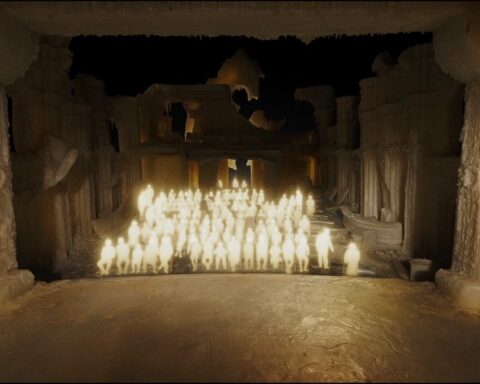
The Hive Mind that emerges in the new world embodies this absolute “oneness.” There are no individual thoughts, feelings, or consciousnesses left. Everyone shares the same happiness, the same knowledge, and refers to themselves as “this individual.” Mental multiplicity vanishes, replaced by a uniform, homogenized consciousness.
Pluribus examines how this ideal unity, instead of being a conscious choice, becomes a virus-like compulsory bonding. Differences are wiped out entirely, with each person forcibly connected to a single dominant mind without any chance to resist. This marks the total annihilation of individuality, identity, and free will.

Carol and the Others
At the beginning of the story, the Pluribus virus emerges as the result of a laboratory leak and rapidly spreads across the globe through biological transmission — such as biting, kissing, or other forms of close contact. The virus links those it infects to a single collective consciousness known as the Hive Mind.
This state of merging into one unified mind expands to nearly all of humanity, turning the entire life experiences, skills, and knowledge of every infected individual into a massive shared pool. The consequences of this are both astonishing and terrifying. A seven-year-old child, for example, can now perform a complex surgical procedure flawlessly thanks to their access to this pool; a forty-year-old who has never traveled can pilot an aircraft with ease by drawing on the collective knowledge of trained pilots.
There is, however, a small group of people who remain unaffected — individuals with natural immunity to the virus. Across the entire world, there are only thirteen such people, including Carol herself.
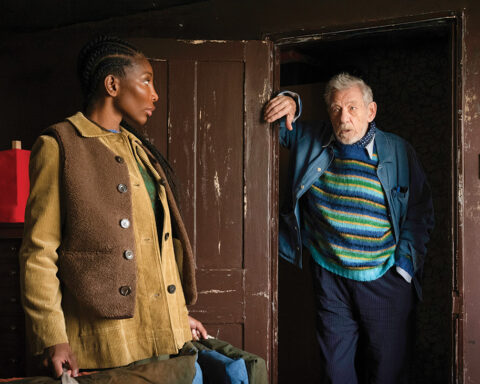
What makes Carol (Rhea Seehorn) uniquely resistant to the virus’s imposed happiness is the fact that, unlike everyone else, she is profoundly unhappy and deeply lonely. Even before the Pluribus outbreak, Carol was on the brink of a personal crisis.
Although the romantic fantasy novels she despises writing have made her rich and famous, this success has only intensified her inner restlessness and her persistent questioning of her life’s purpose. Even before collective happiness became mandatory, she wanted to redirect her career toward something that would allow her to reach her full potential and express her creativity in a way that truly fulfilled her.
For Carol, the virus’s enforced harmony and eradication of sorrow is not a salvation but rather the global imposition of a life she already found hollow, false, and unmeaningful. The virus has tragically interrupted her search for her authentic self and, in doing so, has turned her into the last defender of the very thing she longs for most: individual freedom.
This is what makes Carol’s resistance so vital. She is not merely a dissident — she is the fiercest and most relentless voice of the final remnants of humanity in this new order. While the others who still possess free will have either accepted the situation, learned to benefit from it, or failed to oppose it with Carol’s intensity, she refuses to settle for solitude as the symbol of multiplicity in a world of absolute oneness. Carol is determined to save the world from this virus.

The Forced Imposition of Harmony and Happiness
In the series, the price of achieving “oneness” is the loss of will and autonomy. This illustrates just how dangerously the original motto can be ideologically distorted. Whereas the traditional E Pluribus Unum emphasizes unity through diversity within a democratic context, the Unum in Pluribus represents a totalitarian regime of consent. There is only one “correct” way of living — defined as happiness, yet in truth reduced to numbness and absolute uniformity. Carol’s unhappiness and resistance are perceived as an existential threat to this oneness.
With her immunity, Carol becomes the embodiment of the last surviving form of will. She is the final individual standing against the global mental and emotional merger. Her struggle is the fight for the right of Pluribus — the many — to exist within Pluribus Unum.
So powerful is her presence that every emotion Carol experiences exerts tremendous pressure on the collective mind of millions. Her bursts of anger, sarcastic demands, or emotional crises can inflict severe disruptions — even causing mass casualties. This reveals how her individual pain and rage have transformed into a potent and dangerous political force against the collective order.
Yet despite all this destruction and the consequences of her emotional turbulence, Carol never stops searching for a way to restore the world to its former state. She discovers that individuals connected to the collective mind must operate with absolute honesty — that they cannot lie — and she weaponizes this forced honesty, continuing her solitary resistance.
As a result of her unwavering defiance, every person connected to the Hive Mind ultimately abandons her city, leaving Carol entirely alone — granting her the solitude she longs for, yet in the form of a global abandonment. This shifts Carol’s struggle from a battle for individuality into an extreme allegory of loneliness and alienation in the modern world. It represents the coercion inherent in the demand to “be human,” to conform, to produce. It asserts that genuine existence is not only about acceptance, but also about the capacity to refuse.

The Inevitable Question Gilligan Asks
Pluribus is not merely the story of a virus or a collective consciousness; it is the story of carrying the weight of being human, of understanding the value of pain and free will. Vince Gilligan does more than thrust the audience into a dystopia—he invites us into an unsettling inner reckoning:
Is it better to be truly free, or to surrender to painless happiness?
This choice stands at the center of the conflict between Carol and the collective consciousness in the series’ universe, but it also becomes a silent dilemma we all face in the modern world. In an era where technology, comfort, and enforced conformity grow stronger by the day, Pluribus reminds us of something essential:
What makes us human is not happiness, but the right to choose.
At this point, Gilligan’s words from an interview clarify the intention behind the series: “It was a great moment in the writers’ room where two of my writers argued over this. I just sat back, I was just tickled, because that’s the kind of show I wanted to make.”
Gilligan does not aim to place the viewer in a passive comfort zone. In an age of rapidly advancing technology and artificial intelligence—where minds drift toward numbness, postponing thought, silencing inquiry—Gilligan deliberately stirs conflict. He pushes us to think again, to create again.
And this is precisely where Pluribus becomes most striking — Gilligan never gives us a clear answer. Instead, he leaves a question in our hands:
Are you willing to sacrifice your free will for a painless world? Or, even if the consequences include unbearable sorrow, is it still worth experiencing what makes us human?
Author: Zehra Eda Sert