Nuremberg (2025)
James Vanderbilt
| Dram | 148′
United States
Rami Malek| Russell Crowe| Michael Shannon
Awards & Nominations
4 Wins, 14 Nominations

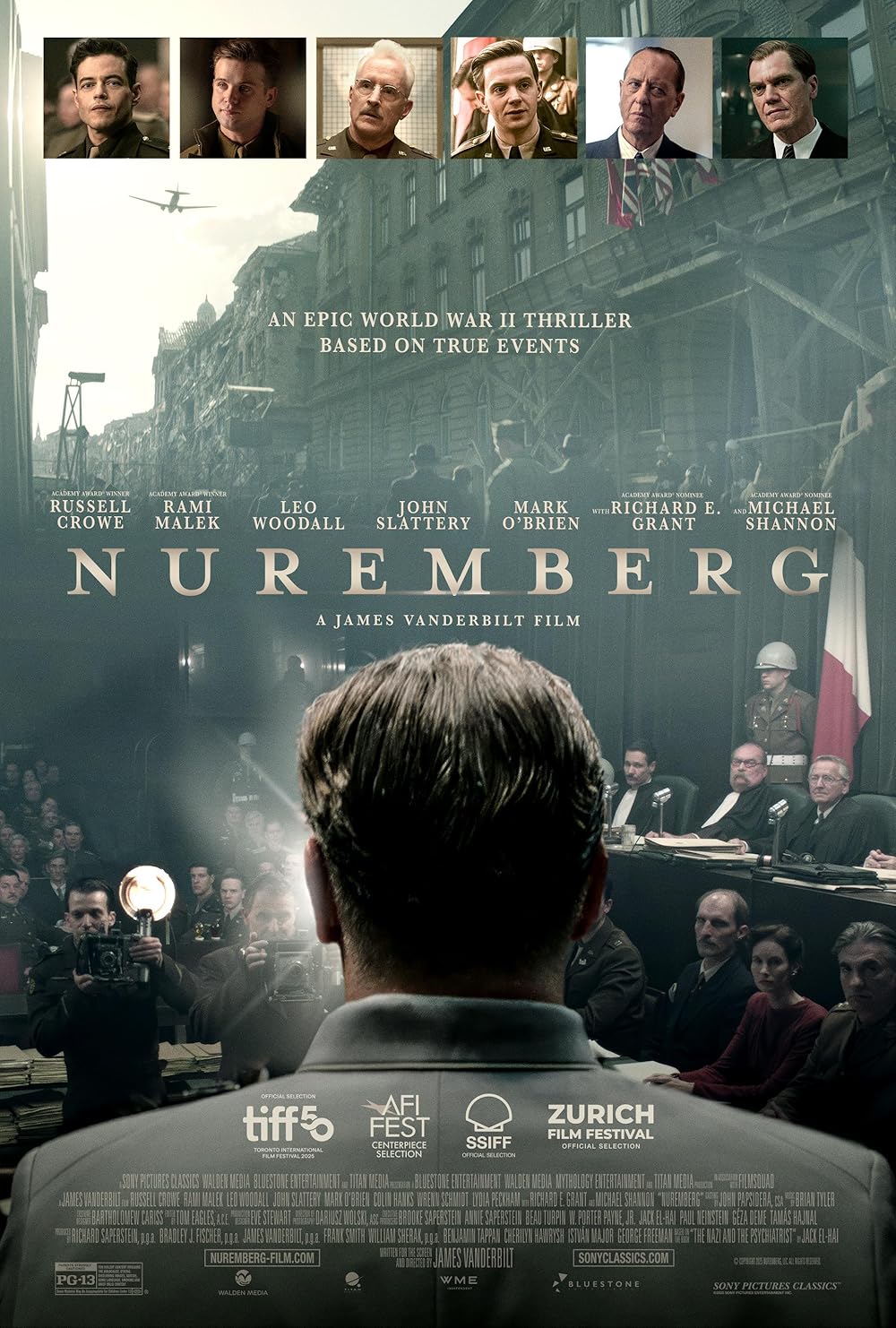
American screenwriter and director James Vanderbilt is known as a filmmaker who has sought to construct political and historical narratives within mainstream cinema through films such as Zodiac, The Amazing Spider-Man, and Truth. Vanderbilt’s 2025 film Nuremberg centers on the Nuremberg Trials, held immediately after World War II, in which the senior leaders of Nazi Germany were prosecuted. Premiering at the Toronto Film Festival, the film brought discussions of historical justice, war crimes, and international law back to the forefront, and sparked intense debate due to its performances and its chosen perspective.
The Nuremberg Trials are not a subject addressed for the first time in cinema history. In this context, the most well-known example remains Stanley Kramer’s 1961 classic Judgment at Nuremberg. Featuring Spencer Tracy, Burt Lancaster, Judy Garland, Marlene Dietrich, Maximilian Schell, and Montgomery Clift, the film continues to serve as a foundational reference for those interested in the topic. Vanderbilt’s Nuremberg, while inheriting this historical legacy, chooses to build its narrative primarily around the character of Hermann Göring. Göring is portrayed by Russell Crowe, while the American psychiatrist evaluating him, Douglas Kelley, is played by Rami Malek.
Like similar works—and in line with the classic reflexes of mainstream historiography—the film largely approaches events from the perspective of the “victors’ narrative.” Although the trial process occasionally attempts to adopt a more distanced and questioning stance, it ultimately takes shape as a spectacle in which the winners stage their own understanding of justice. Nevertheless, certain dialogues and small moments throughout the film invite the audience to look at the cracks in this narrative and create space for questioning.
To better understand this context, it is necessary to briefly return to Germany before World War II. After World War I, Germany was forced to accept the harsh, humiliating, and unsustainable conditions of the Treaty of Versailles. Provisions such as territorial losses, the dissolution of the army, and the prohibition of military production and air forces caused not only economic devastation but also deep psychological damage. While this process fostered profound feelings of shame, inferiority, and humiliation within German society, it also led to the accumulation of strong anger and hatred, particularly toward France and Britain.
It was precisely in this environment that the Nazi Party and Adolf Hitler emerged, promising to restore German identity and “honor,” and succeeded in mobilizing large segments of the population. However, an important point that is often overlooked should be noted here: at that time, the dominant political trend across Europe was the rise of the left and socialism. Fearing this rise, capitalist circles and the bourgeoisie provided significant support to fascist movements in Germany and across Europe. This economic and political background is not made sufficiently visible either in this film or in similar productions. The sympathizers the Nazi regime had in the United States, its ties to American capital, or the connections between major corporations such as Ford and the Nazis are often left outside the narrative.
For those seeking to better grasp this period, the series Babylon Berlin powerfully depicts the social and political atmosphere of Weimar Germany, while Rainer Werner Fassbinder’s adaptation of Berlin Alexanderplatz remains a highly valuable reference for understanding how the social foundations of Nazi rule were formed.
Nuremberg opens with Hermann Göring surrendering to American soldiers together with his family in the final days of the war. It then portrays the trial of 24 high-ranking Nazi officials who were captured alive. At this point, a fundamental reality should not be overlooked: this trial began as a process in which the victors judged the defeated at a time when international law was not yet clearly defined. There was no neutral panel of judges; the judges were appointed by the four countries that won the war. This renders the trial legally and morally contentious from the outset.
The choice of Nuremberg as the location of the trial was also no coincidence. The city held extremely symbolic significance for Nazi ideology: it was regarded as one of the sacred sites of the old German Empire, where emperors were crowned and where Nazi Party rallies were staged with grand ceremonies. The Allies’ deliberate selection of this city reveals that the trial was not only a legal process but also a symbolic display of power.
The film constructs its narrative largely around Göring; however, within a runtime of two hours and twenty minutes, it is naturally impossible to address such a complex and multilayered subject in all its dimensions. Many themes—law, justice, ethics, propaganda, and historiography—are touched upon only superficially. Still, certain scenes stand out as the film’s strongest moments. In particular, Göring’s response to accusations of war crimes—by invoking the bombings of Hiroshima, Nagasaki, and Dresden and questioning American war crimes—constitutes one of the narrative’s key turning points. The fact that this question remains unanswered clearly demonstrates that the trial functions less as a search for universal justice and more as a staging that renders the victors’ own crimes invisible.
The absence of any military necessity for these bombings, which are counted among the greatest civilian massacres of World War II, once again reminds us that there can be no “innocent side” in war. The anger and shock experienced by psychiatrist Douglas Kelley in the face of this confrontation can be read as a moral discomfort produced by being forcibly confronted with a truth he does not wish to hear.
One of the film’s most striking lines emerges in Göring’s answer to the question, “Why did you support Hitler?”: “He made us feel German again.” This sentence encapsulates both the psychology at the center of the film and a warning that remains relevant for today’s world. It shows how nationalist rhetoric built on a sense of humiliation can so easily manipulate the masses. It becomes apparent that slogans such as “Make … Great Again,” used in different countries today, are not all that far removed, formally speaking, from Nazi propaganda.
In the film’s final section, Kelley’s assertion that the crimes committed by the Nazis are not unique to any one society, and that this potential exists everywhere—followed by his exclusion as a result—demonstrates how resistant societies are to confronting their own dark sides. At the same time, the fact that severe racism against Black people continued in the United States during this period, while prosecutors judging Nazi leaders from the podium ignored this contradiction, opens up another important area of debate that the film addresses indirectly.
Finally, it should be remembered that these 24 defendants represented only a small fraction of the Nazi regime. It is now known that approximately 10,000 Nazi officials and officers fled to South America, particularly Argentina, and that it is hardly plausible that this occurred without American knowledge and approval. Likewise, it is a historical fact that thousands of Nazi scientists were employed in American projects after the war—especially in space programs.
Despite all its shortcomings, Nuremberg is significant insofar as it creates space to reconsider these questions and to interrogate the ideological structures behind historical narratives. While watching the film, returning to the ideas of Hannah Arendt—particularly through the concept of the banality of evil—can place this process within a much deeper and more meaningful context.
Author: Ruşen Ertan