
Everybody Digs Bill Evans
________________________
Grant Lee
Docudrama | Biography
112′
U.S.A.
Owen Martell | Mark O’Halloran

Awards & Nominations
1 Wins, 1 Nominations

Jazz is a genre of music that emerged in the early 1900s, rooted in blues and originating from Black communities who migrated from Africa to America. The period between 1930 and 1960 is considered the golden age of jazz. During these years, leading figures of classic jazz composed and performed the genre’s most important works. The majority of these musicians were Black artists. One notable exception to this is Bill Evans.
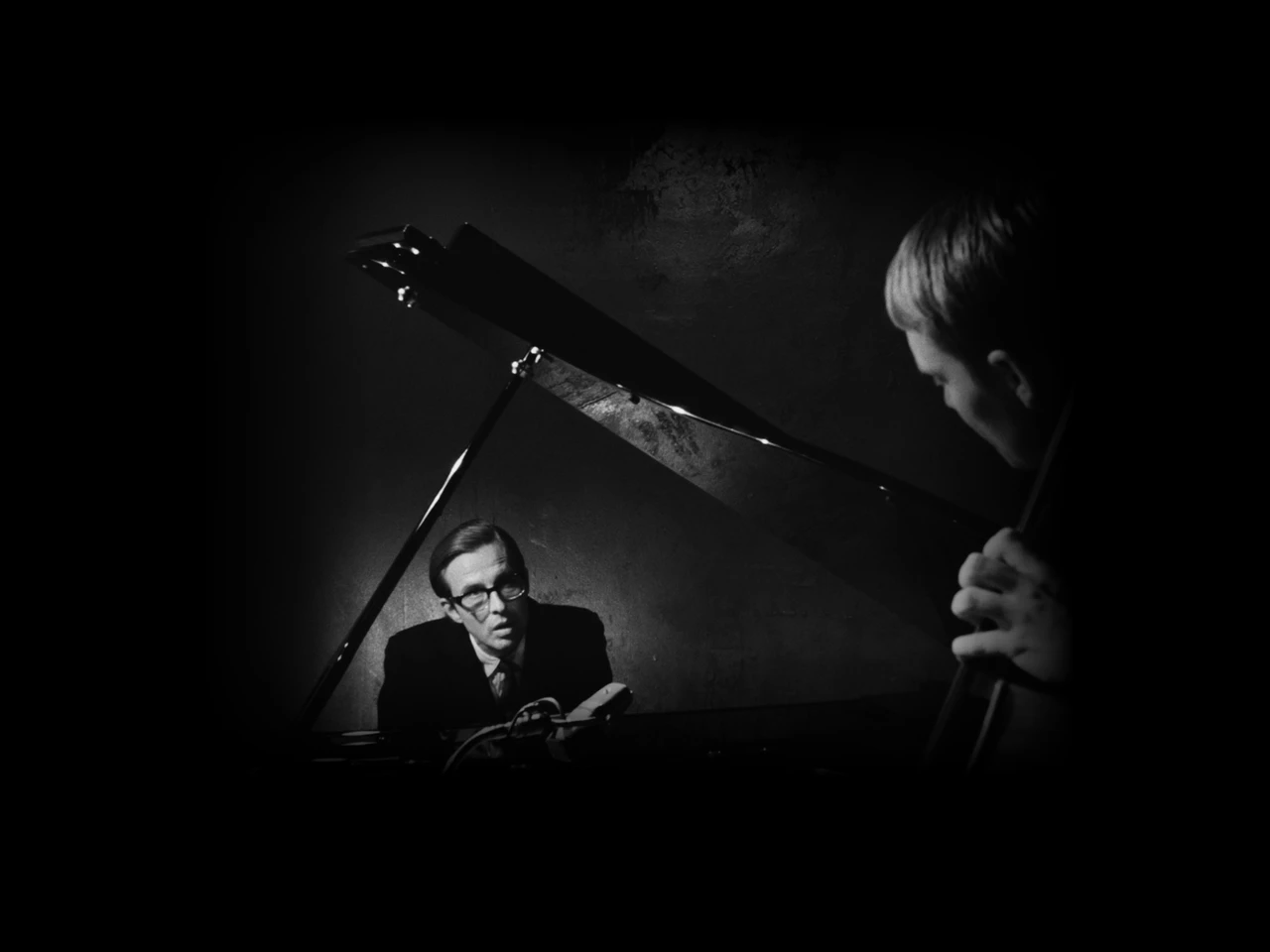
This film presents a brief segment from the life of Bill Evans. The story focuses on the period spanning from the peak of his career to his decline. Director Grant Gee’s background as both a photographer and cinematographer is particularly evident in the film’s visual storytelling. The black-and-white scenes effectively convey the atmosphere of the era. A strong visual contrast is established between the dark, dystopian atmosphere of New York and the bright, calm, and sunny environment of Florida. Another notable aspect is the limited use of music in the film; including more of Bill Evans’ compositions could have further supported the narrative.
One of the key qualities that distinguishes Bill Evans from other jazz musicians is that he was not only a practitioner but also had formal academic training in music. A major turning point in his career was his collaboration with trumpeter Miles Davis. In 1958, Evans joined Davis’s sextet and performed as the pianist on Kind of Blue, one of the most important albums in jazz history.
After leaving the group at the end of 1959, Evans formed his own trio, featuring Scott LaFaro on bass and Paul Motian on drums. In 1961, the trio began performing at the Village Vanguard jazz club. Established in 1934, this venue holds a significant place in jazz history and has hosted many prominent musicians. Live recordings made there constitute an important part of the jazz repertoire. In particular, recordings by John Coltrane and Bill Evans at this venue are among the most notable examples of the genre.
The film begins during this period of Evans’s life. The trio is performing at the Village Vanguard and experiencing one of the most successful phases of his career. However, shortly after, the death of bassist Scott LaFaro in a car accident deeply affects Evans. Following this loss, he struggles emotionally, goes through a difficult psychological period, and distances himself from music for a while.
The film also gives significant attention to Evans’s relationship with his partner at the time, Elaine Schultz. This relationship is portrayed as a negative influence during Evans’s heroin addiction. Schultz’s own addiction further complicates this period for Evans.
During this time, Evans moves to Florida to stay with his family and attempts to recover. Family relationships are presented as a key element in his healing process. Everyday interactions, such as shared activities like golf, are used to depict family dynamics. The narrative includes moments where Evans feels restricted in his father’s presence, yet experiences pride when spending time outside with his son. However, it is not possible to fully verify all aspects of the relationships depicted in the film; alternative interpretations may exist regarding how Evans’s relationship with Schultz and his addiction developed.
This situation can also be examined within the broader context of racial discrimination and social pressures faced by Black individuals in America during that era. At the time, Black individuals encountered significant legal and social inequalities, including restrictions in accommodation, education, and transportation. These conditions may have led some artists to substance use as a way to cope with psychological pressure. However, the presence of similar patterns among white musicians indicates that the issue cannot be reduced to a single cause. Furthermore, although there are ongoing debates about the relationship between high creativity and substance use, no definitive conclusion has been reached.
Drug use, which was common among jazz musicians, is brought to the forefront again through the film. The discrimination and social pressures faced by Black musicians in America at the time are often considered key factors in explaining this phenomenon. Black artists encountered serious limitations in accommodation, transportation, and social life during tours. These conditions may have contributed to substance use. However, the fact that a white musician like Bill Evans experienced similar struggles suggests that the issue is multidimensional.
Despite being a music film, the limited use of music stands out. The acting performances, however, are generally strong. Anders Danielsen Lie, in the leading role, portrays Bill Evans in a highly realistic manner.
The film also mentions that one of Evans’s most well-known pieces, Waltz for Debby, was composed for his niece. Overall, the film explores the impact of family bonds and emotional relationships on the individual, the destructive consequences of emotions such as jealousy, and the personal breakdown experienced by an artist who becomes distanced from creative production.
In general, the film stands out with its performances, cinematography, and atmosphere; it can be considered a compelling work, especially for viewers interested in jazz music.
Author: Ruşen Ertan
Editor: Zehra Eda Sert