
All We Imagine as Light (2024)
Payal Kapadia
Drama | Romance
France | India | Netherlands
Kani Kusruti | Divya Prabha | Chhaya Kadam

Awards & Festivas
45 Win, 98 Nomination

Once Upon a Time in Mumbai
The birth of cinema has progressed hand in hand with the nature of the modern city. When the Lumière Brothers’ cameras first started rolling, they turned their eyes toward a world shaped by industry: train stations, factories, crowded streets. These images were not only documents of everyday life but also expressions of the new regime of vision created by the city — that is, the mental landscape of the modern individual. The camera was capable of capturing the movement, chance encounters, and speed of the city. And for this reason, the first films were, in essence, city films.
Over time, this observational attitude gave way to a more narrative language. The camera began to record not only what happened, but also what didn’t; the moments in which past and future blurred, the dreams, the memories. Thus, city films took on the tone of a fairy tale. The phrase “Once upon a time…” came to symbolize both the nostalgic and fragile dimensions of cinema’s relationship with the city. The city was no longer a backdrop, but a state of mind.
In Antonioni’s films, the city is the silent witness to human relationships — the space of abandonment in L’Avventura, of alienation in L’Eclisse. For Fellini, the city transforms into an internal theatre. Characters wandering through the nights of La Dolce Vita or the ghostly streets of Roma are flâneurs/flâneuses, dreamlike witnesses. As they wander the city, they are in fact wandering through their own inner worlds.
However, in All We Imagine As Light, it may not be accurate to fully identify with this figure. The female characters in the film are not just observers; they are also bodies that transform under the pressure of the city, that strive to exist despite it — silent yet resilient. They are not flaneuses, but the delicate memory of the survivor.
Premiered at the 2024 Cannes Film Festival and awarded the Grand Prix, All We Imagine As Light is Payal Kapadia’s first narrative feature film. Kapadia had previously made a name for herself with short and medium-length works that moved between documentary and fiction. With this film, she left a quiet yet resonant mark not only in Indian cinema but also in world cinema. The fact that she is the first woman director from India to be featured in the main competition at Cannes strengthens the film’s symbolic and representational power.
The film opens with an establishing shot — a general view of Mumbai, a sort of panorama. The following overvoice narrates both our entry into the city and the experience of those who live in it. In the film, Mumbai is not merely a city, but a mood, a climate of feeling. The editing is so transparent, the narration so natural, that it almost gives the impression of a documentary. This mode of storytelling directly references Agnès Varda’s The Gleaners and I (2000). Varda too is a flaneuse figure who perceives cities as spaces of memory, both poetic and critical. Kapadia’s narrator women, like Varda’s gleaners, gather life piece by piece from the gaps of the city.
It is no coincidence that the first sound heard as the curtain opens is the sound of construction; it is a symbol of urban transformation, the pressure of the metropolis, and noise. This directly evokes the concept of “overstimulation” described by German sociologist Georg Simmel in his essay “The Metropolis and Mental Life” (Die Großstädte und das Geistesleben). It signals both progress and the erasure of the individual.
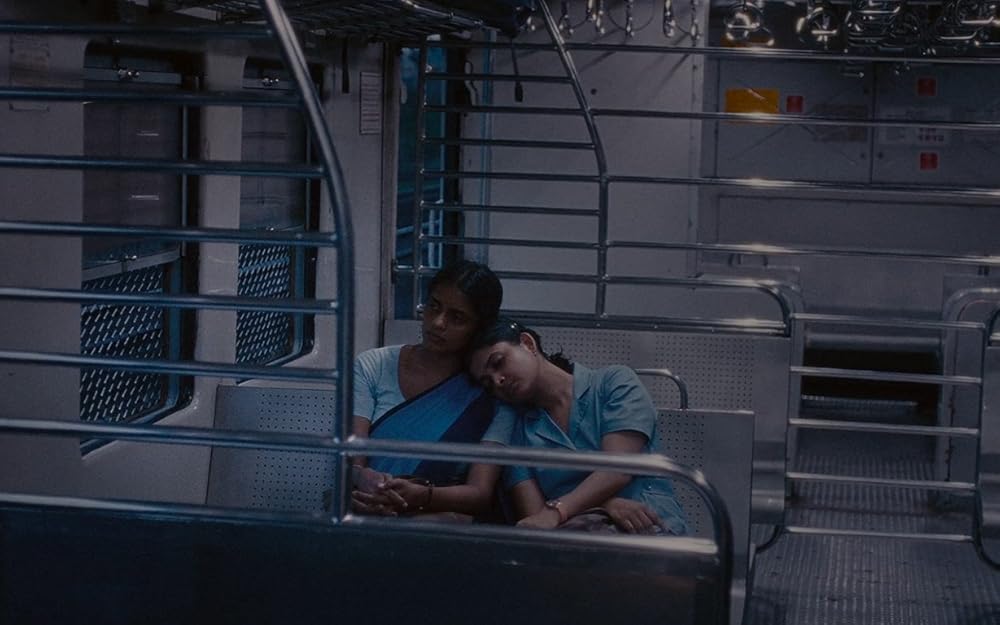
The film follows the lives of two nurses living together in Mumbai. The women are not lost in the chaos of the city; on the contrary, they cover that chaos with silence. The way to protect oneself from the noise of the city is through a kind of inward turn, a kind of partnership and solidarity. With their dreams suppressed by silence, these two women, lost among crowds, build a kind of microcosm within their small home, which they inhabit as a shelter. In other words, they construct an inner world outside the city. Through a gaze that is almost neo-realist, their inner imaginative power creates a space of “light.”
“According to you, the city is a mode of existence shaped by your perspective.” (Simmel)
From here, it naturally leads us to the film’s title, which captures its most metaphysical yet most mundane dimension: All We Imagine As Light — that is, all that we imagine as light. This “light” is neither a physical illumination nor a romantic hope. It is, rather, a space imagined by women who exist unnoticed within the city — a space that is free, calm, speakable. It is a vision of light, a freedom that can exist only at night or through dreams. Perhaps the “spirit” of Mumbai lies here: in a city where everything is not so much happening outwardly but being lived inwardly, imagining light becomes the most delicate form of existence. Just like in Simmel’s reflections on the inner responses developed by the individual against the city.
Because, “The modern individual rationalizes in order to protect herself from the outside world, yet still reconstructs herself through dreams.”
All We Imagine As Light is the present-day reflection of cinema’s first gaze upon the city. The trains of the Lumière Brothers have given way to women going to their night shifts, the rhythm of Berlin: Symphony of a Great City has yielded to the construction noises of Mumbai. But the story being told remains the same:
The city is not a stage, but a state of mind.
And some films illuminate that state of mind with silence.
Nil Birinci


