
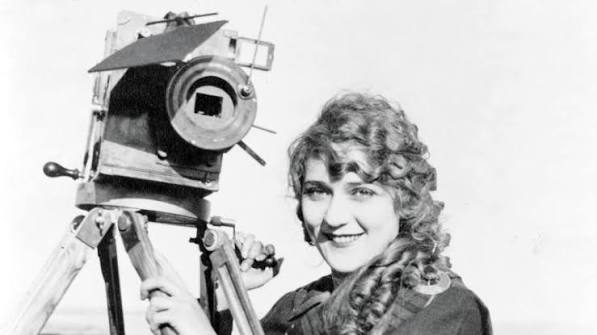
History of Women Horror Film Directors (1896–1945)
A Chinese proverb says, “Women hold up half the sky.” In other words, women, just like men, are not only witnesses to both good and evil but also their agents. Yet when it comes to understanding and representing this reality, the situation changes completely. Patriarchy does not merely tell women what they can do; it also dictates how they will be remembered and how they will be represented. Stories in which women are subjects and agents are continually redefined through the male gaze. Women are capable of both kindness and cruelty, yet the way these qualities are interpreted is determined by gender. When women show compassion, it is treated as natural; when they exercise power, it is framed as pathological. What is considered “character” in a man often becomes a moral problem in a woman.
In cinema, this mechanism becomes even more deeply entrenched. Within mainstream filmmaking, women are repeatedly cast as victims, saints, or femme fatales. When goodness is associated with women, it must be passive, self-sacrificing, and silent. When evil is associated with women, it becomes something that must ultimately be punished.
Given such deeply rooted problems of female representation, one may argue that there should be no distinction such as “women directors.” This is, however, a complex issue. Those who oppose the label point out that placing the qualifier “woman” before “director” implicitly reinforces the assumption that the default canon remains male. From this perspective, they have a valid argument. Horror cinema, however, differs from other genres. It is fundamentally concerned with the body, perceptions of threat, vulnerability, and the loss of control—all experiences that are profoundly gendered. For women, the body itself is a site of constant vulnerability. Both private and public spaces are less secure. The likelihood of becoming a victim is significantly higher, to the point of becoming almost ordinary. Consequently, horror is not an exceptional emotion for women but an everyday condition.
Many male horror directors externalize the source of fear. The body frequently functions as an object of spectacle. Female characters are either victims or survivors, yet their trauma is almost always aestheticized. Laura Mulvey’s concept of the male gaze operates within horror cinema not only as an erotic gaze but also as a punitive one. Because masculinity functions as the unquestioned norm, there has never been a need to create a category called “male directors.”
Among women horror filmmakers, however, recurring patterns emerge. Threat often originates from within intimate spaces—the family, friendships, or the home—or it already resides within the woman’s own body. The body ceases to be a spectacle and instead becomes the subject itself. The monster is not merely an external creature but a structural force generated by social systems, body politics, and the violence embedded in everyday life. Trauma is not represented as a singular event but as an ongoing condition. This is unsurprising, because for women, as argued above, horror is ordinary. It is daily. It is internalized from birth. For this reason, discussing a distinctly female perspective within horror cinema is not simply justified but necessary. Here, “woman director” is not an identity label but an analytical lens through which we can better understand how horror itself is constructed. For men, horror often emerges from losing control; for women, horror stems from never having been granted control in the first place. These two experiences of fear are so fundamentally different that they cannot produce the same cinema.
Since almost the very beginning of the medium, horror has been one of the genres women have gravitated toward because it allows historically silenced experiences to be expressed both metaphorically and literally. Yes, from the very beginning. Yet when we think of the late nineteenth century, few of us can name a single woman directing horror films. The reasons for this absence deserve careful examination.
In recent years, horror cinema has gained increasing critical legitimacy. More horror films are now directed by women. While large-budget horror productions remain largely under male control, a growing number of women filmmakers have embraced horror as a powerful form of artistic expression. One reason for this increase lies in the subjects these films explore. Many of them are narratives of resistance against societies that punish, restrict, or mistreat women. For women who experience structural powerlessness in the face of dominant forms of violence, horror possesses a unique appeal. Challenging taboos and advancing radical critiques of religion are among the genre’s most enduring strengths. Such acts of destruction ultimately benefit everyone—but it is difficult to deny that one gender has considerably more to gain from them.
What we now recognize as horror cinema largely emerged during the second half of the twentieth century. Although some films produced at the end of the nineteenth century and the beginning of the twentieth century are retrospectively classified as horror, contemporary audiences often find this categorization difficult to understand. Yet the spectators who watched these films at the time experienced reactions comparable to—or even stronger than—those produced by modern horror films. For that reason, this study will also refer to them as horror films.
The first feature-length horror films appeared during the 1920s. Film scholarship commonly identifies silent works such as The Cabinet of Dr. Caligari as early examples of the horror genre. By the 1930s, films such as Frankenstein and Dracula had begun to define horror cinema, although their horror elements remained relatively restrained by contemporary standards. It would not be until the second half of the twentieth century, with films such as Psycho and Blood Feast, that horror cinema would fully develop into the form we recognize today.
With this historical context established, we may now turn to the earliest women directors who worked within the horror genre.
Alice Guy-Blaché
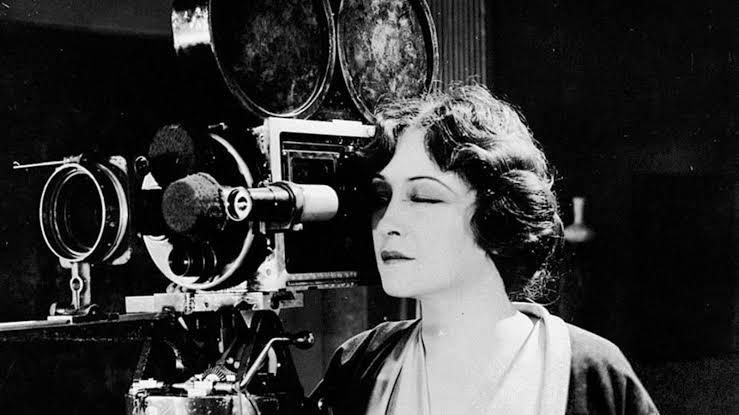
Women’s presence within the horror genre dates back to the very origins of cinema. When examining this early period, one of the most important figures we must acknowledge is Alice Guy-Blaché. Active between 1896 and 1920, many of her suspense-oriented works have been lost, with only a handful of film reels surviving today.
In 1896, there were no film studios, movie stars, professional actors, or cinematographers as we understand them today. A film director was responsible for every stage of production: writing the screenplay, casting actors, designing costumes and sets, arranging the lighting, filming, and editing the finished work. Directing was not yet considered a prestigious profession. Perhaps for this reason, Guy-Blaché, then employed as a secretary at Gaumont, was simply handed a camera. At a time when women were still denied the right to vote, they had already begun directing films.
During these early years, films were regarded as “living photographs.” Cinema primarily consisted of recording moving images of real people already engaged in an activity—for example, a dancer performing. Capturing movement itself was considered the essential objective. The idea of constructing a fictional narrative specifically for the screen had not yet emerged. Guy-Blaché was among the first filmmakers to write an original story and transform it into a film, thereby breaking with cinema’s initial function of merely documenting reality.
Her film The Cabbage Fairy (La Fée aux Choux), composed of a simple two-scene narrative, featured actresses wearing costumes created specifically for the production and performing as fairies. The exact year of its production remains contested. Guy-Blaché herself maintained that she made it in 1896, while some scholars date the film to 1900. Film historians likewise continue to debate whether *The Cabbage Fairy* or Louis Lumière’s 1895 silent comedy *L’Arroseur Arrosé* (*The Sprinkler Sprinkled*) should be recognized as the first fictional narrative film. For this reason, it is more accurate to describe Guy-Blaché as one of the first filmmakers to create narrative cinema. However, if we define narrative filmmaking as the deliberate staging of actors, costumes, and constructed sets, then the distinction rightly belongs to Alice Guy-Blaché.
Reflecting on women’s place within the emerging film industry, Guy-Blaché wrote:
“There is nothing connected with the staging of a motion picture that a woman cannot do as easily as a man, and there is no reason why she cannot master every technical aspect of the art… Women have long held their place among the most successful workers in acting, painting, music, and literature, and when one considers how vitally these arts enter into the making of motion pictures, it is curious that there are not dozens of women’s names among the most successful motion-picture directors.
— Alice Guy-Blaché, The Moving Picture World, July 11, 1914
One of the films that justifies recognizing Alice Guy-Blaché as an early director of suspense cinema is “Surprise Attack on a House at Daybreak” (1898). As its title suggests, the film depicts a group of armed men launching an attack on a house. Another significant work is “Faust et Mephistopheles” (“Faust and Mephistopheles”), a short adaptation of Johann Wolfgang von Goethe’s famous work. Some film scholars regard it as the first fantasy film directed by a woman. We know that the two-minute film required approximately forty-four meters of film stock. What fascinated both contemporary audiences and later film historians was Guy-Blaché’s innovative editing technique, which allowed the Devil to appear and disappear through cinematic trick effects. The film can be viewed here:
Guy-Blaché was also the first filmmaker to adapt ‘The Hunchback of Notre-Dame’ for the screen in 1905. In one interview, she recalled that the most difficult sequence to film in the ten-minute production was Quasimodo’s torture scene. She also noted that she was reprimanded by the company’s board of directors for using an excessive amount of film stock during production. Today, only a few production stills survive; the film reels themselves have been lost. The 1923 adaptation directed by Wallace Worsley and starring Lon Chaney as Quasimodo is generally regarded as the first screen version of “The Hunchback of Notre-Dame”. Historically, however, this is incorrect.
In 1906, Guy-Blaché directed the short film “The Consequences of Feminism”, in which she humorously reverses traditional gender roles. Running only seven minutes, the film is widely considered one of the earliest feminist films. Women possess economic and social power, while men occupy the domestic and social roles traditionally assigned to women. Considering that women at the time were still fighting for fundamental rights such as suffrage and access to education, the film can be understood as a remarkably radical satire. By transforming contemporary debates on gender into cinematic form, it became a pioneering work in film history. The film can be viewed here:
In 1910, Guy-Blaché resigned from Gaumont and moved to the United States with her husband, settling in New Jersey. There they founded their own production company, Solax Studios. Reflecting on the differences she observed between Europe and the United States regarding women’s status, she remarked:
“The attitude toward women is very different in America. In a French studio, whenever a woman tries to direct or supervise the work of men, there is constant conflict. Men do not like it, and they make no effort to conceal their feelings.”
In 1913, she directed “The Pit and the Pendulum”, an adaptation of Edgar Allan Poe’s story of the same name. The film is frequently cited as the first horror film directed by a woman. Guy-Blaché understood that American audiences sought romance, terror, and adventure, and her adaptation incorporates all three. In Poe’s story, a prisoner of the Spanish Inquisition is confined within a dungeon containing a deadly pit at its center while a giant pendulum blade slowly descends from the ceiling. The prisoner is subjected to both psychological and physical torture. Guy-Blaché presents these dungeon and pendulum sequences with striking dramatic intensity, creating a distinctly Gothic atmosphere. Some scholars even regard the film as one of the earliest cinematic expressions of Gothic aesthetics. The gradual movement of the pendulum also demonstrates an early and sophisticated use of cinematic time and suspense. Adapting a literary work by Poe was itself an innovative undertaking at the time. Unfortunately, only the first reel of the original three-reel film survives today. It can be viewed here:
After Guy-Blaché’s husband founded Blaché Features in 1913, Solax Studios gradually became inactive. Alice subsequently directed three films for the new company. The first, *Shadows of the Moulin Rouge*, is an exceptionally dark drama. It tells the story of a woman named Mrs. DuPont, who is kidnapped by a villain named Chevrele and taken to the Moulin Rouge nightclub. Chevrele murders a prostitute and places the body in Mrs. DuPont’s bed so that her husband will believe his wife has been killed. While attempting to uncover the truth, Mr. DuPont is committed to a psychiatric institution, and the couple must endure numerous hardships before finally being reunited.
The other two productions, ‘The Dream Woman’ and “The Woman of Mystery”, were both released in 1914. “The Dream Woman” is another deeply disturbing narrative centered on an alcoholic woman who behaves almost like the Devil and ultimately murders her husband. “The Woman of Mystery” combines romance with elements of mystery and the supernatural. It follows an actress named Norma, who becomes the target of a mysterious Hindu princess attempting to murder her by sending her a box filled with poisonous snakes. Detective Nelson investigates the crime and imprisons the princess. Using powerful psychic abilities, however, the princess compels Nelson to commit an armed robbery. The following day, he is shocked to discover his own scarf at the crime scene. Assisted by Norma and her mother, Nelson clears his name and pursues the escaped princess after she breaks out of prison. Once cornered, she commits suicide by swallowing poison concealed within a secret compartment in her ring. Unfortunately, the reels of this unusual film have also been lost, making it impossible to view today.
Many of Guy-Blaché’s later films feature the archetype of the seductive femme fatale. Morally corrupt yet beautiful, dangerous, and destructive to those who love her, this character type emerged during Guy-Blaché’s era and continues to be one of cinema’s enduring female archetypes.
The closure of Solax Studios forced Guy-Blaché into early retirement. Unable to secure directing work in the United States, she returned to France, where she spent the next three decades lecturing on cinema and writing for film journals. Tragically, every copy of the films she made in America has been lost. She died in New Jersey in 1968 and was buried in the Catholic Cemetery in Mahwah. There was no one to publish an obituary announcing her death.
Rosa Porten
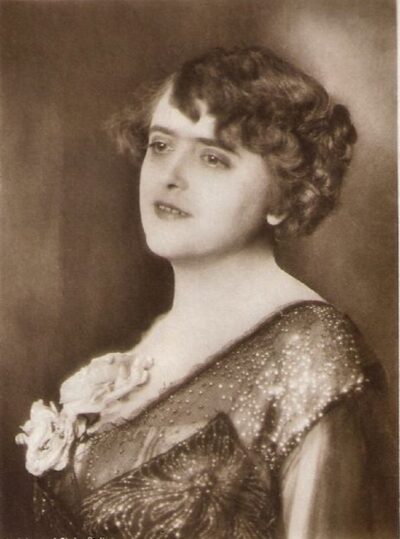
Born in 1884, Rosa Porten was one of Germany’s first women film directors. By 1910, she was already writing screenplays and co-directing films with her husband, Franz Eckstein. Compiling a complete filmography of her directorial work is difficult, as film archives from the period were often incomplete or inaccurate, and she also worked under pseudonyms. One of these was Dr. R. Portegg. Working primarily for the production company Treumann-Larsen-Film GmbH, she directed mostly dramas and comedies, although many of her films can also be regarded as early examples of horror cinema.
Among the films she co-directed with Eckstein was Der nicht vom Weibe Geborene (The One Not Born of Woman, 1918). The film starred Conrad Veidt—later celebrated for his leading roles in The Cabinet of Dr. Caligari and The Man Who Laughs—as the Devil. The title alludes to the famous line from William Shakespeare’s Macbeth: “None of woman born shall harm Macbeth.” Unfortunately, both the film and its synopsis have been lost. Nevertheless, surviving accounts and historical research indicate that it presented a Gothic atmosphere built around inevitable fate, cursed prophecies, and uncanny figures. The film is frequently described as an early precursor to motifs that would later become central to German Expressionist horror cinema.
Another horror film directed by Porten was Das Geschenk der Norne (The Gift of the Norn, 1916). In Norse mythology, the Norns are three supernatural women who determine the destinies of human beings, much like the Moirai in Greek mythology. Here, the “gift” refers not to a blessing but to the inescapable burden of fate. The film is regarded as one of the earliest examples of pagan and mythological horror. Its portrayal of femininity as both a creative and threatening force was highly unusual for its time. The film also demonstrates that German cinema possessed a fascination with shadows, death, and Gothic imagery even before the emergence of full-fledged German Expressionism.
Porten also directed numerous comedies under the pseudonym Dr. R. Portegg. One of them, Wanda’s Trick (1918), holds particular significance within feminist film history. The film presents a heroine who stands in direct opposition to what Virginia Woolf would later describe as the “Angel in the House.” Wanda uses her intelligence and cunning to navigate and manipulate a male-dominated society to her advantage. She is an active subject in both romantic and social relationships, capable of influencing and outmaneuvering the men around her. Rather than functioning as an object of desire, the female protagonist becomes the architect of the narrative itself. Porten’s decision to work under a masculine pseudonym is therefore unsurprising; it was one of the few available strategies for gaining credibility within the overwhelmingly male-dominated film industry.
Tragically, none of the films directed by Rosa Porten have survived. She died in 1972 at the age of eighty-eight.
Louise Kolm-Fleck
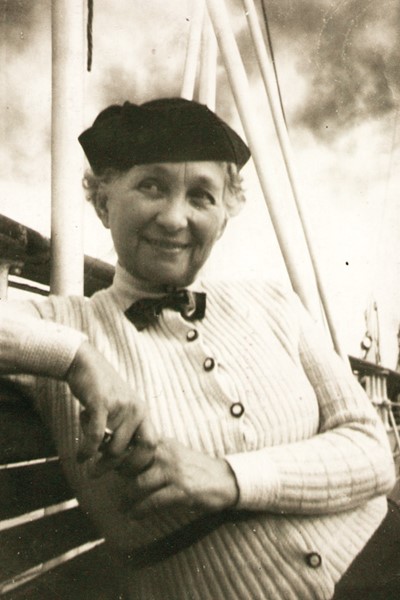
Louise Kolm-Fleck (also known as Luise Kolm, Luise Kolm-Fleck, Luise Veltee, or Luise Fleck) is an Austrian filmmaker who remains relatively unknown among horror film enthusiasts. She worked as a producer and director from the final years of the Austro-Hungarian Empire through the end of the Second World War. Together with her first husband, Anton Kolm, and cinematographer Jacob Fleck, she co-founded the Austrian-Hungarian Cinema Film Company Ltd.
In 1912, Kolm-Fleck co-directed the horror film Trilby with Jacob Fleck, Anton Kolm, and Claudius Veltée. Adapted from George du Maurier’s novel, the film tells the story of the young and beautiful singer Trilby O’Ferrall and her sinister, manipulative mentor, Svengali. Although Trilby possesses no natural musical talent, Svengali takes her under his control and, through hypnosis, transforms her into a brilliant opera singer. Permanently trapped in a hypnotic trance, Trilby is unable to ask for help or escape his influence. She remains under his supernatural control until Svengali dies of a heart attack. Following this pioneering adaptation, the story of Svengali would be brought to the screen nine more times, most recently in 1983.
Her feature-length silent ghost story Die Ahnfrau (The Ancestress, 1919) is regarded as one of the earliest horror films directed by a woman. Running approximately one hour, the film is a Gothic tale set in a Renaissance-inspired fantasy world. Count Zdenko von Borotin (Karl Ehmann) and his daughter Berta are the last surviving members of an ancient noble family, living together in their ancestral castle. Yet the castle is haunted by a restless ghost—the spirit of a medieval ancestress who had been forced into marriage against her will. After being discovered in the arms of her lover, she was brutally murdered by her husband as punishment. Now, as a ghost, she returns to haunt her descendants.
The film features a number of striking special effects, including scenes in which the ghost vanishes and reappears amid gusts of wind that billow her long dress through empty rooms. It also contains disturbing imagery for its time, including the bodies of executed robbers hanging from tall poles. Shortly after its premiere, the film reels disappeared, and portions of the surviving print became badly deteriorated. Fortunately, the film was partially restored by the São Paulo Cinematheque in Brazil and was screened once again at the Austrian Film Festival in 2019, exactly one hundred years after its original release. The restored version can be viewed here:
In 1920, Kolm-Fleck and Jacob Fleck co-directed another horror film, Anita. The film once again centers on a young woman placed under the influence of a hypnotist, echoing themes explored in Trilby. Unfortunately, no surviving copy of the film is known to exist.
Following the death of Anton Kolm, Louise married Jacob Fleck in 1924, and the couple relocated to Berlin. In 1927, they co-directed the thriller Die Yacht der sieben Sünden (The Yacht of the Seven Sins), a feature-length serial killer film starring Brigitte Helm, one of the great stars of Weimar silent cinema. The story follows singer Leonie Storm and dancer Olga Petrowna, who find themselves caught in the middle of a murder mystery aboard a luxurious passenger yacht. The film can be viewed here:
By 1938, Jacob Fleck had been imprisoned in the Dachau concentration camp because he was Jewish. After his release in 1940, the couple fled together to Shanghai, where they collaborated with the Chinese filmmaker Fei Mu. Following the end of the Second World War, they returned to Austria in 1947. Louise Kolm-Fleck, whose filmmaking career had begun there decades earlier, died in Austria in 1950.
Musidora
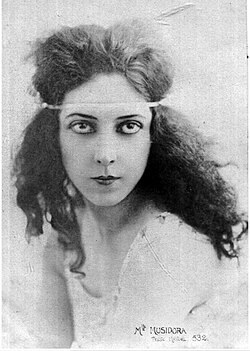
Born Jeanne Roques but known professionally simply as Musidora, the French actress—who later became a director—first rose to prominence through her collaboration with Louis Feuillade. She portrayed Irma Vep (an anagram of the word vampire) in Feuillade’s celebrated silent crime serials. In Les Vampires (1915), she embodied the seductive vampire-like femme fatale whose image would become one of the defining icons of early silent cinema.
Working closely with Feuillade, Musidora went on to direct at least ten films during the 1910s and 1920s. Unfortunately, almost all of her work as a director has been lost. Only two films survive:
Soleil et Ombre (Sun and Shadow, 1922):
La Tierra de los Toros (The Land of the Bulls, 1924):
Musidora’s lost Gothic thriller Vincenta (1920) was a story of murder and passion set in Spain’s Basque Country and filmed at the Château de Madame du Barry in France. The narrative follows Prince Romano, who seduces a waitress named Vincenta before cruelly abandoning her after announcing his engagement to a wealthy American heiress. As Vincenta’s heartbreak drives her into emotional turmoil, another man, Morenito, murders her in a fit of obsessive love. Musidora herself played the title role. She later acknowledged that one of her principal inspirations for the character was the story of Princess Badourah from One Thousand and One Nights.
Musidora’s creative achievements extended well beyond acting and directing. She was also a novelist, journalist, and film archivist. During the final years of her life, she worked intermittently at the ticket office of the Cinémathèque Française. One cannot help but wonder whether any of the cinemagoers purchasing tickets from the elderly woman behind the counter realized that she had once been the star of the very films they had come to watch.
Elvira Notari
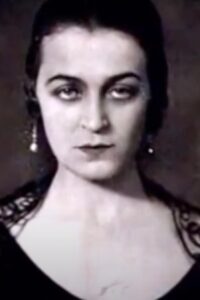
Elvira Notari is widely recognized as Italy’s first woman film director. She began her career as a photographer in 1905 and founded her own production company in 1912. After directing several short films, she made Il Nano Rosso (The Red Dwarf, 1917), adapted from Italian writer Carolina Invernizio’s 1905 novel Raffaella, ovvero I misteri del vecchio mercato (Raffaella, or the Mysteries of the Old Market). The story follows Raffaella, an innocent young woman who is kidnapped by criminals and repeatedly sold to different individuals. Driven to madness by her ordeal, she spends much of the narrative under the influence of drugs administered by fraudulent doctors to keep her submissive.
Notari also directed several suspense films adapted from works of Romantic literature. Carmela, La Sartina di Montesanto (Carmela, the Seamstress of Montesanto), and La Medea di Portamedina (The Medea of Portamedina, 1919) were all based on novels by the nineteenth-century Italian writer Francesco Mastriani.
Filmmaking was very much a family enterprise. Her husband worked as the cinematographer, while their son Eduardo appeared as an actor in many of her productions. Eduardo affectionately nicknamed his mother “The General,” a title that reflected the remarkable authority she exercised on set. The nickname was well deserved, as Notari imposed strict rules on her performers. She insisted, for example, that tears seen on screen had to be genuine rather than produced with glycerin. Actors were expected to draw upon painful or emotionally vulnerable moments from their own lives in order to achieve authentic emotional expression.
Although Notari is primarily associated with melodramas and films depicting everyday life, her work consistently focused on marginalized communities, class divisions, and social conflict. Many of her films feature the femme fatale as a woman who defies social norms, while simultaneously foregrounding female subjectivity, the female body, and female desire. In films such as ‘Nfama! and A Piedigrotta, women occupy the central role and are portrayed as rebellious rather than submissive.
Desire itself became one of Notari’s recurring themes. Whereas male desire is typically directed toward possession—wanting someone as an object to acquire or control—female desire in her films is represented differently. It is connected to the symbolic realm: the desire to be desired, to be awaited, remembered, spoken about, or inscribed within another person’s story. As Darian Leader argues from a Lacanian perspective in Why Do Women Write More Letters Than They Post?, these differences reveal fundamentally distinct structures of desire.
Toward the end of the 1920s, the Fascist regime in Italy brought independent film studios under increasing control through censorship and political pressure. The realistic and socially uncompromising stories that Notari chose to tell stood in direct opposition to Fascist ideals, which promoted an idealized image of Italy founded on national unity, strength, and superiority. There are no ideal Italians in Notari’s cinema. Instead, her films depict poverty, crime, prostitution, and social decay. They are spoken in the Neapolitan dialect rather than standardized Italian, and working-class life is made visible rather than romanticized.
For these reasons, the films produced by Dora Film—named after one of her children and founded with her husband—were frequently censored under Benito Mussolini’s government. In reality, these films illuminated aspects of Italian life that many considered too vulgar or undesirable to portray. They often featured coarse language, sexual innuendo, and an unflinching depiction of everyday existence viewed through a distinctly female perspective. To circumvent censorship, Dora Film removed the prohibited scenes to create an approved domestic version while sending the uncensored prints to Italian immigrant communities in the United States. Thanks to this strategy, at least part of Notari’s cinematic legacy survived.
Elvira Notari, the modest creator of a popular cinema that authorities sought to suppress, died in 1947 at the age of seventy-one.
Eloyce Gist
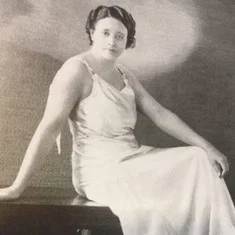
Eloyce Gist was a Black filmmaker working during a period when Black Americans were excluded from the film industry and subjected to systemic discrimination in nearly every aspect of society. Together with her husband, James Gist, she produced films featuring all-Black casts for predominantly Black audiences. Their work was deeply rooted in Christian evangelism, and Gist herself was an Evangelical Christian whose films were explicitly intended to convey religious messages.
One of her best-known works, Hell-Bound Train (1930), runs approximately fifty minutes and is generally regarded as a feature-length film. Its premise is straightforward yet striking: dressed in a Halloween mask and a flowing red cape, the Devil serves as the engineer of a speeding train bound for Hell. He offers sinners free one-way tickets in exchange for their souls. Each group of passengers represents a different sin, introduced through a series of short episodic scenes. The first carriage is occupied by dancers, whose performances are presented as symbols of immorality. The second contains bootleggers. Other carriages are filled with unmarried mothers carrying infants. Women become victims of sexual violence, men are robbed, and jazz music accompanies many of these sequences—presented, from the film’s moral perspective, as music befitting the Devil himself. At the conclusion of most episodes, Satan laughs as he gathers yet another soul for his infernal train. All of the passengers are ultimately condemned to Hell. As the train approaches its destination, marked by a sign reading “Welcome to Hell,” it enters a cave and bursts into flames.
The film can be viewed here:
Because of the technical limitations under which Gist worked, many of her images acquire an unexpectedly surreal quality. Faces disappear into darkness, bodies seem suspended in empty space, and the homemade Devil costumes, though almost childlike in their simplicity, become strangely unsettling. At times the narrative itself fragments, blurring the boundary between reality and dream and leaving the viewer uncertain whether what unfolds on screen should be understood as literal or hallucinatory.
Following the death of James Gist in 1940, Eloyce Gist withdrew from filmmaking. For a time, she continued to travel with her films, using them as part of her evangelical ministry while screening them for Black communities. Eventually, however, she could no longer sustain this work on her own. She devoted herself to her family and gradually disappeared from public life. The date and circumstances of her death remain unknown—a poignant reminder of how poorly the lives and achievements of Black women artists have been documented and preserved. Today, Eloyce Gist deserves recognition as one of the earliest filmmakers to shape what would later become America’s tradition of conservative religious horror cinema.
Author: Yasemin Akman