
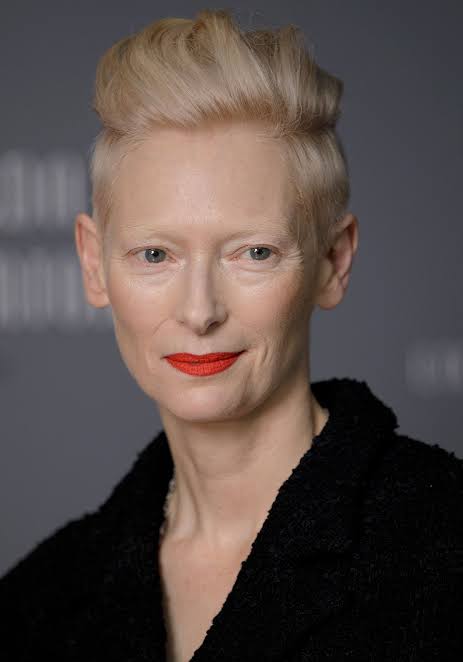
Not of This World: Tilda Swinton
“Goodness and Beauty, Order and Chaos, the Bohemian way of life and Bourgeois conventions are the result of a perfect balance between them. Bohemian chaos alone results in a mad jumble of beautiful fragments; Bourgeois conventions alone result in great, soulless corpses.” A quote from a letter W. H. Auden wrote to Benjamin Britten, which Tilda knows by heart. It is written on a postcard she has kept tucked among all her books ever since she began working in the film industry. And it is perhaps the perfect one-sentence summary of Tilda’s biography.
Katherine Matilda Swinton was born in London on November 5, 1960, but has always identified herself as Scottish above all else. The Swinton family is one of Scotland’s oldest families, with a lineage reportedly traceable back to the 9th century. Her father was the 7th Laird of Kimmerghame, making him a member of the Scottish aristocracy. Her family also includes notable figures who were responsible for inventions ranging from television to the tank.
Born into Kimmerghame’s centuries-old aristocratic lineage, Katherine Matilda would go on to become Tilda: one of cinema’s most unconventional, unclassifiable, and experimental actors. And her family? They were intelligent enough to simply want their children to be happy.
A comfortable life awaited her at the upper echelons of society. Yet she quietly rebelled against it. After spending two years volunteering in a township in South Africa and then in Kenya, she went to Cambridge to study political science and English literature.
She later performed at the Traverse Theatre in Edinburgh and, after graduating, joined the Royal Shakespeare Company (RSC). Swinton realized that she did not fit in with the company’s ethos and left the RSC after a year. Ever since, she has expressed an antipathy toward live theatre:
“I’m not one of those actors who says theatre is their great love… To be honest, I’m not interested in theatre at all… I find it very boring.”
She graduated from the University of Cambridge with a degree in Social and Political Sciences.
“There was no film department. If there had been one, I would have studied there,” she says. “Quite the opposite. I had never acted, and I was a poet. I was a complete fraud. I was accepted as a poet. I went there and stopped writing. I started performing very reluctantly.”
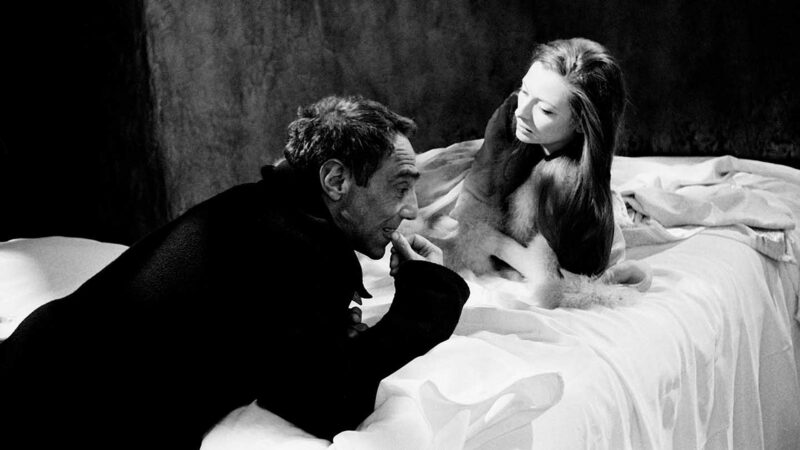
By the time Tilda graduated, she was certain that she did not want to become a conventional actor, either in the industry or on the stage. She knew she wanted to do something related to cinema, but she had no idea what. On the recommendation of a friend, she met Derek—who was, at the time, in the process of casting his film Caravaggio. (Caravaggio would also become Tilda’s first professional film.)
Over the course of nine years, they worked together on seven films.
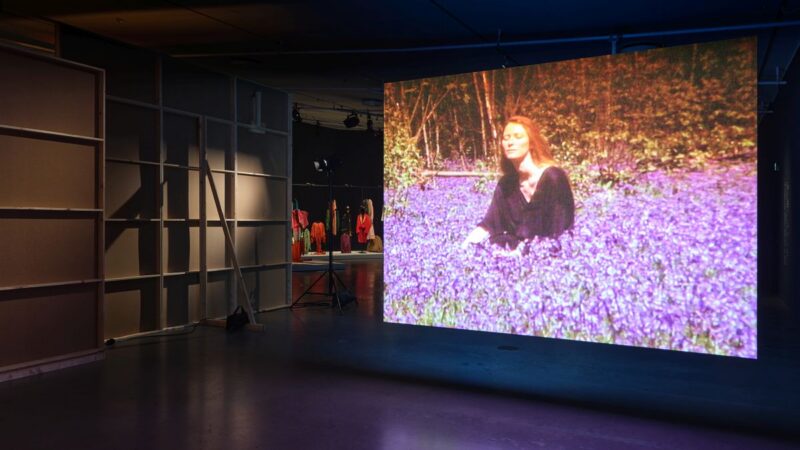
If we look at Timeslip (1988) and The Last of England (1987), the short films in which Tilda first experimented with acting, we see a shy young woman who doesn’t like speaking in front of the camera. She moves freely, occasionally offering tiny glances, completely natural and unselfconscious.
Tilda herself often emphasizes that from the moment Derek rang her doorbell, she welcomed him with a camera, recording every moment, gradually preparing her for the person she would become by blurring the boundaries between real life and film.
“When Derek died, I lost my way,” she says. “My connection with the camera was severed. I didn’t know what an experience with a camera without him could even be.”
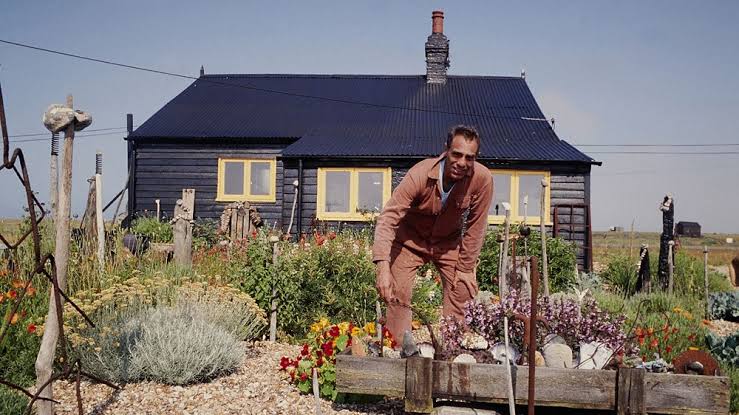
Tilda spent a great deal of her time with Derek at The Cottage, which became both an AIDS activist house and a gathering place for many of the era’s important artists—a place she continues to return to in a sense. When Jarman died of AIDS-related pneumonia in 1994, she was performing The Maybe. In 2008, she made Derek, a film dedicated to him. We could write pages about him, but to summarize him in the context of this piece: Derek was the single most important person in transforming Tilda from a shy cinenerd into the professional, singular, utterly original performer she became.
In her own words: accurate — be yourself — authentic — personal. She seems almost like the embodiment of these four words. And Tilda’s character is so much more: alien. She uses this word herself quite often—the idea of being foreign, other, not of this world. She turns this position on the margins, this chosen difference, into an aesthetic attitude. In that sense, she really isn’t an “actor” in the conventional sense of the word. She prefers to call herself a performance artist.
In her own words again: “I might be wearing a Virgin Mary costume, but I’m responding as a woman of our time—as myself, essentially.” This is what she does in countless films: not inhabiting a role, but dissolving herself and reassembling within the character, while remaining herself (with the exception of The Human Voice, which will be discussed later in the piece).
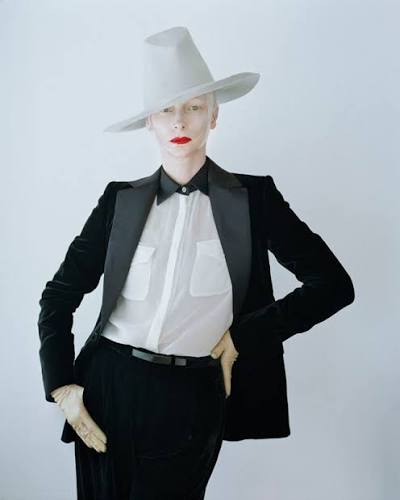
The first thing that comes to mind when we think of Tilda’s style is androgyny. But in her case, it ultimately leads many viewers toward a conception of gender outside social norms, transforming her position on the margins into a conscious aesthetic stance. Swinton’s androgyny gave her persona a fluid, mutable quality: the ability to dissolve herself while remaining simultaneously striking and otherworldly, even at the most extreme points of transformation. Although “androgyny” is a term frequently used to describe her, it fails to fully encompass the scale of her transformations. Rather than changing gender, her work is concerned with time travel, transcending expectations, escaping, doubling or multiplying, being more than one thing at once. This is the rich psychological territory her career has explored.
As for her career: Tilda has been on screen for over 40 years, appearing in 106 films, producing 13, and writing 4. At the 2007 Academy Awards, where Cate Blanchett was a favorite for I’m Not There, Tilda won the Oscar for Best Supporting Actress for Michael Clayton, despite having relatively little screen time. She has won two BAFTAs, received a special award from MoMA, and was awarded an Honorary Golden Bear at the Berlin International Film Festival. In 2020, The New York Times named her one of the greatest actors of the 21st century.
She did not limit herself to acting. In 2005, at the age of 51, she was featured in the Turkish Pavilion at the Venice Biennale as part of Hussein Chalayan’s Absent Presence project.
In this piece, we will only be able to touch upon a handful of the 106 films Tilda has appeared in. But there is a common attitude that runs through many of her characters—one we have already touched upon in the introduction, in terms of how closely it mirrors her own personality. It is a character that seems to have settled into her posture, her face, her very identity. And particularly during the first half of her career, she often played women trying to maintain control while trapped under unbearable pressure, overwhelmed by grief, chaos, suffering, or desire.
The passage from oppression to free will—how autobiographical is that, really?
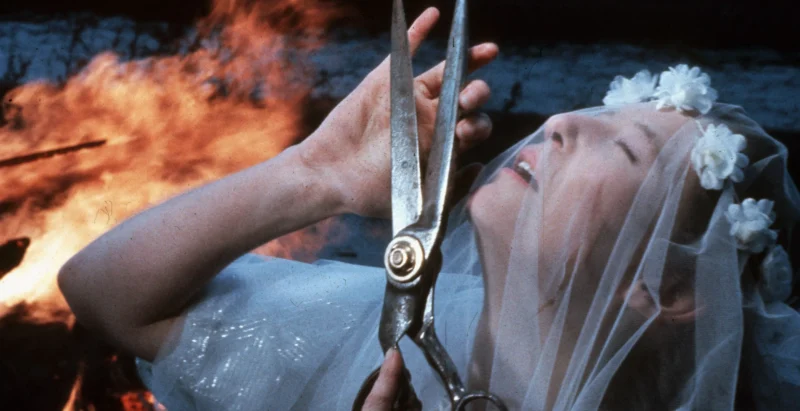
Let us remember that early in her career, in Jarman’s The Last of England (1987), there is a scene in which she tears apart her wedding dress. It can be read as a striking response to her family’s expectation that she would marry an aristocrat.
Author: Nil Birinci