

The Cow (1969)
Dariush Mehrjui
Dram | 104′
İran
Ezzatolah Entezami| Mahin Shahabi | Ali Nasirian

Ödüller ve Festivaller
6 Ödül , 7 Adaylık
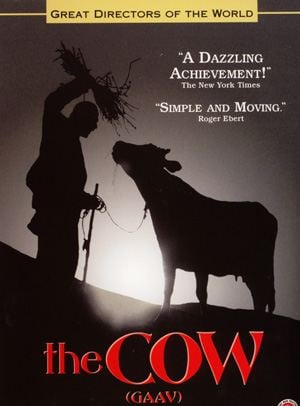
Although only Daryush Mehrjui’s second feature film, Gaav (The Cow) is widely regarded as one of the works that determined the fate of Iranian cinema. Considered a precursor of the Iranian New Wave, the film created not only a national but also a global rupture by bringing the local into dialogue with a universal cinematic language.
The film is set in an enclosed village near Shiraz. In this village, Hasan’s cow—an animal with which he has formed an almost human bond—dies. The villagers conceal the truth from him. Unable to accept the loss, Hasan gradually begins to take the cow’s place. The film slowly traces the dissolution of identity.
With minimal contact with the outside world, the village functions as a microcosm of Iranian society: class, religion, property, masculinity, fear, and solidarity overlap within the same confined space. Yet the film is not “Iran-specific.” On the contrary, through primitive human reactions to loss, it articulates a universal condition of existence. The villagers are portrayed neither romantically nor exotically.
Character Structure
Hasan is the owner of the village’s most valuable asset: the cow. He is addressed as “Mashti Hasan,” a title in popular usage that combines respect and familiarity. Mashti signifies someone “from among us”—an ordinary, lower-class man with masculine honor but without intellectual distinction. Throughout the film, Hasan is repeatedly framed not as an autonomous individual but as someone defined through the village’s collective language. His bond with the cow emerges from this condition: he himself is not a “subject” but a being reduced to an economic and symbolic function—just like the cow.
There is also Mashti Eslam in the village, a kind of “village educator” whose religious knowledge guides others. Islam appears here as a system that offers solutions; yet Mashti Eslam lies, makes wrong decisions, and succumbs to fear. The film does not present religion as absolute truth, but as a fragile structure carried by human hands. Concealing the cow’s death from Hasan is not an individual lie but a collectively organized one—truth is suppressed communally. As will be discussed later, this suppression does not protect; on the contrary, it deepens the collapse. The repression returns through Hasan’s body.
The Bolourîs are often read as representations of Iran’s fear of “external powers” or “foreign threats.” They are the incomprehensible outside force for the villagers—frequently interpreted as modernity, the city, the state, the market, or property relations. However, as Mehrjui himself stated in an interview, their primary function is psychological rather than political. The Bolourîs are not a concrete external threat, but a mechanism through which fear is internally produced and guilt externalized. People terrorize themselves; fear reproduces fear. The Bolourî threat is constantly invoked in the villagers’ language, and for this reason, the specter of terror permanently hovers over the village.
At this point, the film suspends the familiar “enemy” figure of modern narrative. The Bolourîs appear in bodily form in only one scene: they arrive at night, attempt to steal the cow, and are chased away. They never become characters. They have no faces, inner lives, or motivations. They are not figures, but functions. The threat becomes embodied but never resolved or rendered meaningful—it has already been internalized.
Becoming-Animal
From a Deleuzian perspective, the Bolourîs cannot function as classical antagonists (Enemy → Conflict → Resolution). The film does not externalize conflict; instead, it internalizes antagonism. The Bolourîs are not the enemy of becoming-animal, but rather a potential trigger for it.
Hasan’s movement toward the cow does not rely on representation. This relationship is not symbolic; it cannot be reduced to metaphor or allegory. Hasan does not “play” the cow, nor does he imitate it. What occurs is a becoming. Deleuze’s concept of becoming-animal resonates precisely here. Hasan detaches from the speeds and slownesses of the human form and enters the rhythm of the cow; space changes, posture changes, voice changes. This transformation is not coded as madness. It is presented as the consequence of a body that can no longer exist as human.
For Deleuze, becoming-animal offers a line of flight from the formlessness that paralyzes life and strips the subject of itself—a chance to reattach to life. As Deleuze and Guattari write: “Becoming (animal) is not to imitate a dog, nor to establish relations of analogy. I must succeed in endowing my body with speeds and slownesses that would transform it into a dog, by means of an original assemblage that in no way involves resemblance or analogy. For I cannot become dog without the dog itself becoming something else… Elements enter into new relations, and this results in affects or becomings… Two organs can be placed into a relation that uproots them from their specificity and initiates a becoming together.”
(Deleuze & Guattari, 2004: 258–259)
Yet this becoming is not per se liberating. When Hasan’s cow dies, the village loses not only an animal but also the order that makes humans human. At its core, the film does not tell a story; it carries a collapse. Madness is not treated as individual deviation but as a social rupture or structural trauma.
Mehrjui’s camera does not dramatize this destruction. On the contrary, it dissolves slowly within the everyday. The village’s language, gazes, and silences settle into Hasan’s body. This is not psychological insanity but the result of social determinism.
Structure and Form
The opening scene foreshadows this conceptual trajectory. We witness an exorcism ritual steeped in Islamic mysticism: something is being expelled from a body—ritual, sound, repetition. Later in the film, this scene returns almost inverted: this time, they attempt to expel the cow from Hasan’s body. Beginning and end are bound by the same ritual. This repetition renders time circular, suggesting that collapse is not linear but inevitable.
While presenting Iran as a prototype, Gaav openly depicts ritual and belief systems that Western audiences might perceive as “mystical” or even psychedelic. Simultaneously, it engages in a strong dialogue with Western cinematic traditions. The impoverished spaces and non-professional faces of Italian Neorealism, the formal audacity of the French New Wave, and the shadowy human figures reminiscent of Bergman’s The Seventh Seal are all palpable. The film does not position East and West against one another; it stages their conflict within the same body.
The film’s departure from commercial cinema, its reconstruction of everyday life through a critical and poetic language, and its treatment of character not as an individual but as embedded within a collective social context have led critics and historians to identify Gaav as the first film of the Iranian New Wave.
Its fluid movement between genres therefore never feels jarring. Gaav is a psychological drama, yet it also contains moments of humor through exaggerated theatrical expressions and lines bordering on parody. The string music in the background generates tension, as if heralding an impending crime or catastrophe. At times, the use of light and bodies recalls German Expressionism, causing the film to verge on horror. These transitions are not eclectic; they all orbit the same fragile structure.
Gaav is not about a cow. Nor is it about a village. It is about the forms a body is forced to assume in order to survive in a world where being human is no longer bearable. This is why, half a century later, it remains heavy—alive, unsettling.
National Censorship and International Recognition
Gaav was initially supported by the Shah’s regime, but was soon banned for portraying rural poverty, structural fragility, and social collapse too “nakedly.” It is known that the Shah requested Mehrjui to add an intertitle stating that the poverty depicted belonged to a period twenty years prior to his economic reforms. Mehrjui refused.
Censorship attempts did not silence Gaav; instead, they turned it into a symbol of resistance. A copy of the film was smuggled abroad, allowing it to circulate internationally. It was sent to the Venice Film Festival, where—despite being screened without subtitles—it created a strong impact and received the FIPRESCI Prize. It was later shown at Cannes Directors’ Fortnight (1971) and Berlin (1972), where it received the OCIC Prize and Forum Recommendation, becoming another milestone in the recognition of Iranian cinema at European festivals. The film also drew attention in the United States; Ezzatolah Entezami won Best Actor at the Chicago Film Festival (1971) for his role as Mashti Hasan.
As the film gained international acclaim, it increasingly conflicted with Iran’s domestic censorship policies. Interestingly, after the 1979 Iranian Revolution, Ayatollah Khomeini is reported to have praised the film—an event that prompted renewed reflection on cinema’s role in the revolution’s cultural strategy. Gaav thus became one of the first powerful international faces of Iranian cinema: a masterpiece that entered circulation through censorship and became visible through prohibition.
Author: Nil Birinci