Stille Freundin (Silent Friend)
Ildikó Enyedi
Biyografi | Drama
Almanya | Fransa | Macaristan
Tony Leung Chiu-wai | Luna Wedler | Enzo Brumm

Awards and Festivals
11 Win, 6 Nomination

The Long Story of a Silent Friend
Ildikó Enyedi is a filmmaker who blurs the boundaries between humans and nature through her cinematic language. Words like “poetic” and “intuitive” are frequently used to describe her work. In On Body and Soul, she masterfully disrupted a sensory-based narrative by situating it within a liminal space between dream and reality. With Stille Freundin she extends this trajectory, this time directing her gaze toward a tree.
The film, which received the FIPRESCI Award at the Venice Film Festival, has clearly found strong resonance among critics.
It makes sense to begin with the film’s uncredited lead: the Ginkgo Biloba. Known as a “living fossil” this species has remained almost unchanged for millions of years and is therefore associated with temporal continuity, memory and resilience. Considered sacred in the Far East as a symbol of wisdom and believed to enhance memory through extracts derived from its leaves the tree comes to embody both a memory that transcends time and a form of knowledge that exceeds the limits of human perception.
At a moment when the concept of humanity is being intensely questioned alongside the rise of artificial intelligence, Enyedi turns her attention to a form of continuity that exists within nature but often escapes human awareness. The idea that the hierarchical structure placing humans at the top of the pyramid might give way to a relational network in which all beings exist on the same plane (posthumanism) finds its cinematic expression in the tree Enyedi transforms into a character. As people come and go the tree remains; time in a sense flows through it.
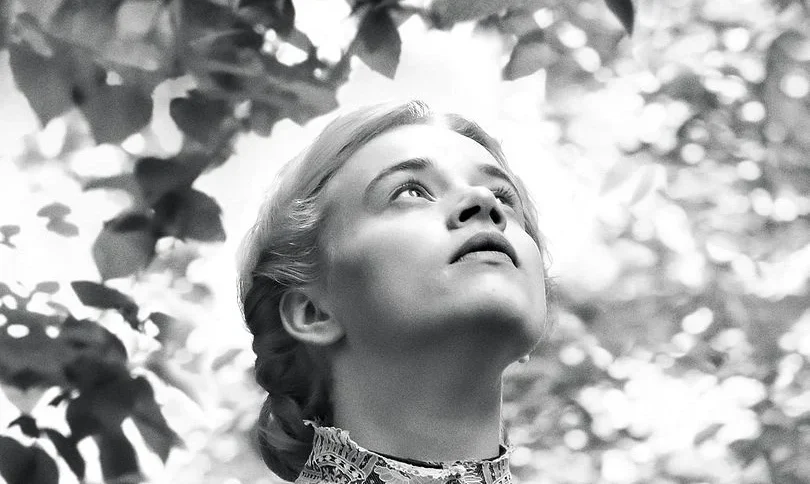
The span of time explored in the film covers more than a century of the Ginkgo Biloba’s life. Structurally, the film is divided into three periods: 1908, 1972, and 2020. Rather than following a linear narrative it moves between these timelines through temporal jumps. To prevent the viewer from getting lost, each period is distinguished through distinct visual strategies: the 1908 segment is composed of static frames (35mm, black and white), the 1970s adopt a freer, handheld aesthetic (16mm, grainy color) and the present day is rendered through a cleaner, more controlled digital image. Transitions between these periods are supported by subtle sound bridges and movements that aim to maintain continuity.
On paper these editing choices appear highly deliberate, in practice however they fall short of achieving the desired fluidity. Transitions are at times overly abrupt, while certain sequences feel unnecessarily prolonged. The connections between scenes tend to distract rather than establish rhythm. Combined with the film’s overall lack of focus and its tendency to linger on superfluous passages this results in a missed opportunity for refinement. It is somewhat ironic that a film concerned with nature, growth and continuity overlooks the importance of pruning as a condition for healthy development.
The representation of women across the three periods is similarly problematic. The figures a repressed woman in the early 20th century, a liberated woman in the 1970s, and a contemporary woman caught between production and care suggest a historical trajectory, yet they rarely move beyond the level of representation. At times the Ginkgo Biloba itself repeatedly framed in close-ups and wide shots achieves a greater sense of depth as a character than the women around it.
At this point, it is possible to situate the film’s thematic concerns alongside two cultural references. The film’s attempt to attribute a form of consciousness to nature and to grasp what lies beyond visible perception recalls Maurice Maeterlinck’s The Intelligence of Flowers, which similarly approaches plant life as a domain of intuitive awareness. Likewise, the film’s treatment of female roles across different periods, connected through the figure of a tree bears a certain affinity to Éric-Emmanuel Schmitt’s The Woman in the Mirror.
Ultimately, the irony of a film that seeks to evoke the invisible bond between humans and nature within the artificial environment of a dark cinema accompanied by fabricated birdsong and controlled lighting could only have been overcome by the power of cinema itself. When that power proves insufficient, one is left with the unavoidable sense that a direct encounter with nature a simple walk in the forest might offer a far more compelling experience.
Author: Zeynep Bakanoğlu