Sinners (2025)
Ryan Coogler
Horror | Action | 137′
America
Miles Caton | Saul Williams | Andrene Ward-Hammond

Awards & Nominations
21 Wins, 19 Nominations

Released worldwide and in Turkey in April 2025, Sinners is a film that contains all the beauties of cinema, one of the fine arts. Sinners is already guaranteed a spot on the “Best Films of 2025” lists. In the following section, we will examine why the film is such a high-quality production. First, let’s delve into what is perhaps the most important indicator of this:
Leaving a genuine mark on cinema and making the whole world speak favorably of you is, as Stanley Kubrick once said, “like writing Crime and Punishment inside a crashing car.” In other words, it is incredibly difficult to achieve. Before its release, Sinners was anticipated yet accompanied by doubts about whether it could meet expectations. These doubts vanished once the film premiered, because Sinners received high praise from both critics and audiences.
One of the most important reasons Sinners stands out artistically is this: The film is an extremely well-blended work. It draws upon the strengths of multiple genre cinemas, forming a perfect cocktail. Supernatural horror, blues musical, drama, thriller, period film, action! All of these come together like a shining concoction prepared by a skilled mixologist for our enjoyment. For this reason, director Ryan Coogler deserves great praise — because he is also the writer of the original screenplay. It’s truly a striking, memorable, and impactful story.
Sinners is one of the original-screenplay films of the 2020s that achieved the highest-grossing opening. For a while, cinema has been dominated by sequels. 95% of the year’s top-grossing 20 films are sequels or adaptations. Producers avoid taking risks. So, the success of a film with an original screenplay and a relatively risky $90 million budget is extremely important. Moreover, the film’s primary genre is horror — making such a risky achievement even more impressive.
To briefly summarize the plot: In 1932, World War I veterans Smoke and Stack, after working for Chicago gangs (including as enforcers for Al Capone), return to Mississippi. With the money they stole from gangsters, they buy a lumber mill from a notoriously racist landowner, Hogwood, to turn it into a juke joint for the local Black community. Their cousin Sammie, who wants to become a famous blues guitarist, joins them despite his preacher father’s opposition, claiming blues music invites supernatural evil. The opening night — October 16, 1932 — becomes a day so unforgettable that it turns into a legendary myth.
Since the symbolism in the film is highly valuable and enriching for readers, the remainder of this piece examines the film’s symbols, metaphors, and references to other major works:
The early scenes show Black laborers working in cotton fields, sweating so that white men can lay their heads on soft pillows and wear comfortable cotton clothes. In other words, Black people are gathering “white cotton” for “white comfort.”
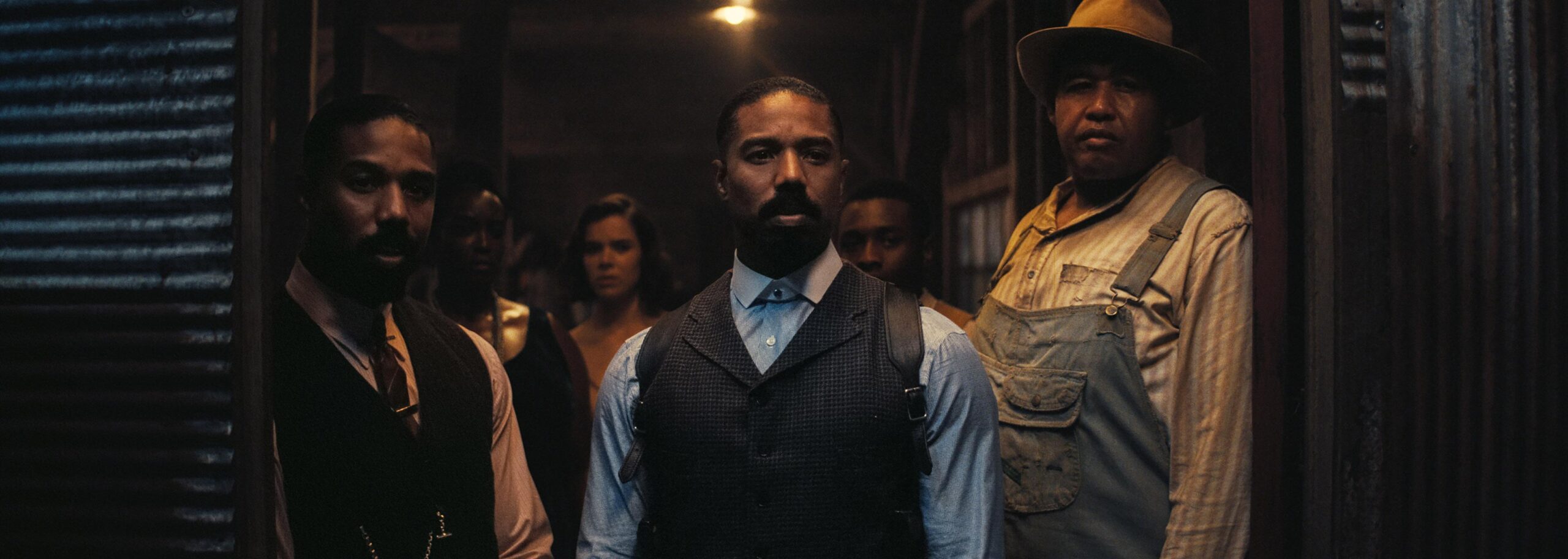
The details in the clothing of the twins Smoke and Stack, played by Michael B. Jordan, help us understand their personalities. Stack, with a red hat and vest, is hot-blooded, impulsive, and volatile — “a sharp vinegar that damages its own barrel.” Smoke, wearing a blue vest and English-style cap, is more rational, political, yet ultimately more dangerous. He is mentally superior to Stack, capable of heroic action. Stack, however, traumatized by a white woman, cannot confront his past and undergoes assimilation. In English, “stuck” means “trapped,” and Stack’s transformation into a vampire mirrors this — his soul trapped in a dead body.
Smoke killing a snake is a foreshadowing — it tells the viewer that he will later deal a decisive blow to an important vampire. As expected, Smoke eventually kills the head vampire, Remmick.
Native Americans in the film appear as mounted patrol units in town, responsible for the security of white districts as well. They warn that vampires are roaming outside their territory. In mythology, Native Americans are associated with werewolves; werewolves and vampires have an agreement not to hunt in one another’s lands. Their presence here suggests that the real danger has infiltrated the town.
Many scenes involve “money” and “bargaining.” Here money symbolizes filth and corruption. Its roots lie in Africans brought to America as slaves for profit. The film critiques how white men, empowered by wealth, spread their dirty dealings throughout society and even attempt to obtain spirituality through these means.
The film draws major inspiration from two earlier works. The first is John Carpenter’s 1982 masterpiece The Thing. That creature assimilates every living organism it touches, overwriting its genetic code. In Sinners, vampires represent Europeans who migrated to America and assimilated not only the enslaved Africans but everyone. The high point of the Thing reference is the garlic test — used to determine who has turned into a vampire. Garlic burns them, smoke rises from them when they try to chew it. This parallels the blood test in The Thing.
The second major inspiration is From Dusk Till Dawn. Though critics were lukewarm, 90s film lovers adored it. Directed by Robert Rodriguez and written by Rodriguez and Quentin Tarantino, the film shifts into a vampire movie in the second half, as Sinners does. Coogler has openly stated that he is a huge fan of horror and drew inspiration from this film. He was also inspired by Rodriguez’s The Faculty, which resembles a university-set version of The Thing.
Speaking of Tarantino, Sinners references two of his anti-racist films. The first is Django Unchained (2012), where Django avenges his mentor by massacring white slaveholders — similar to Smoke slaughtering the Ku Klux Klan members in Sinners. It also recalls the scene in Inglourious Basterds where Hitler and Nazi officers are killed in a cinema.
A key scene involves the vampirized Stack asking Smoke to open the door, insisting he is fine (which is impossible). This mirrors Stanley Kubrick’s The Shining (1980), especially the scene where Jack tries to persuade Wendy from inside the pantry.
The presence of two Asian/Chinese victims highlights the cultural mosaic of the Mississippi Delta. It should not be interpreted as commentary on U.S.–China trade tensions. Vampires attack them not because they are Black, but because they are “other.” Similarly, Turkey’s south and southeast — Hatay and Mardin, for example — share this cultural mosaic.
Mary, played by Hailee Steinfeld, is a pivotal character. She carries Black ancestry on her mother’s side and is accepted by the Black community, evident from her accent. She becomes the juke joint’s first internal victim. Her white heritage enables her empathy with the three vampires. Remmick manipulates her through Irish folk music, assimilating her. When she returns to the juke joint, she is no longer “Mary,” and must request entry — vampires cannot enter uninvited, a rule reiterated throughout the film.
Delroy Lindo’s character Slim recalls his earlier role as a dark sorcerer in The Devil’s Advocate (1997). In Sinners, however, he is on the side of light and fights bravely to protect his friends.
The lumber mill turned juke joint stands on soil stained with the blood of Black victims murdered by the Ku Klux Klan. The first white family Remmick turns is also part of the Klan — evident from their repulsive white hood. He recruits his army from these members.
The entire story begins and ends in the church where Sammie’s father preaches. The church is a sanctuary for Black people. The preacher’s warnings to Sammie are accurate. The juke joint, however, is a den of sin: gambling, alcohol, dancing, sex — earthly pleasures inviting bad spirits. Sammie’s beautiful music, though uplifting, is essentially a dance with the devil.
Sammie’s stunning guitar represents the unstoppable power of Black music — specifically the blues. With this weapon, he wounds Remmick, whose appearance echoes Nosferatu, and Smoke drives a wooden stake into Remmick’s heart. Through music, the Black community resists assimilation and exploitation. The blues first invites the devil, and then destroys him. The dawn catastrophe experienced by Remmick and his followers is the visual apex of this symbolism.
—In this section, let’s say a few special words about the film’s “true protagonist,” Sammie:
This film about the “Sinners” is actually the story of 21-year-old Sammie. He is precious and must be protected because he embodies the cultural memory of his community — the young representative of blues music. All major events occur because of him, and every character faces an epic trial triggered by Sammie’s actions. Coogler emphasizes this through the mid-credits and after-credits scenes. Let’s first examine the mid-credits scene:
It is October 16, 1992 — 60 years later. Sammie, now 80, has become a legendary blues guitarist. When he returns backstage, Stack and Mary approach him, unchanged because they are vampires. Stack offers him immortality. Sammie refuses because he has already achieved immortality through music. He will die peacefully at home — his art kept him unassimilated and allowed him to remain the voice of the Black community for six decades. In this scene, his reflection does not appear in the mirror, like a vampire. Why? For that, we go to the after-credits scene:
In the final scene, Sammie sings in the church, without the iconic claw scars on his cheek — meaning the legendary night has not yet happened. As he smiles at someone while singing, we understand he is making a pact with dark forces. In return for fame and longevity, he gives his soul. This is why his reflection is invisible earlier. Sammie always knew his father was right — that playing the guitar would attract dark visitors and that he would eventually face that terrible night. The cost of his future fame may be high for his cousins and community, but his later ability to inspire millions and preserve Black culture makes it worthwhile.
Coogler drew inspiration from the real blues musician Robert Johnson (born 1911 in Mississippi). Legend says Johnson met the devil at a crossroads, exchanged his soul, and received a magically tuned guitar. He became famous but died at 27, allegedly poisoned by a jealous husband. Coogler, like Tarantino, alters reality to create an alternate universe: in the film, Sammie does not die at 27 but lives long, portrayed in old age by real blues legend Buddy Guy (aged 88).
Speaking of real-life references, Robert Johnson is said to have started the “27 Club” curse — Brian Jones, Jimi Hendrix, Janis Joplin, Jim Morrison, Kurt Cobain, and Amy Winehouse all died at 27.
Sinners centers on America’s recent past and the values of Black culture. Therefore, it is more significant for the U.S. than the rest of the world. This is reflected in its box office, which largely comes from domestic (U.S. + Canada) sales. Thus, it’s unlikely the Academy will overlook it. Sinners will surely be a major contender during awards season — at the Golden Globes and the 98th Academy Awards.
And so, dear reader, this is the cinematic spirit and magic carried by Sinners. I recommend this important film to all cinephiles. It pays homage to cinema’s glamorous eras, criticizes intelligently through symbolism rather than emotional manipulation, and blends genres masterfully. All these elements make it a unique and beautiful experience — placing it firmly among the “Must-Watch Films.”
Author: Volkan Çağlayan